*This post may contain affiliate links for which I earn commissions.*
Quick Summary
Pack a 12-piece Provence capsule anchored by a washed linen midi dress, a flat leather espadrille with a jute sole, and a loose linen shirt in olive or stone for the market mornings and Luberon hilltop lanes. A wide-brimmed straw hat and a wicker basket bag handle the direct summer sun and the long lunch culture. Skip the structured leather handbag. A market basket does the job better here.
The Regional Portrait
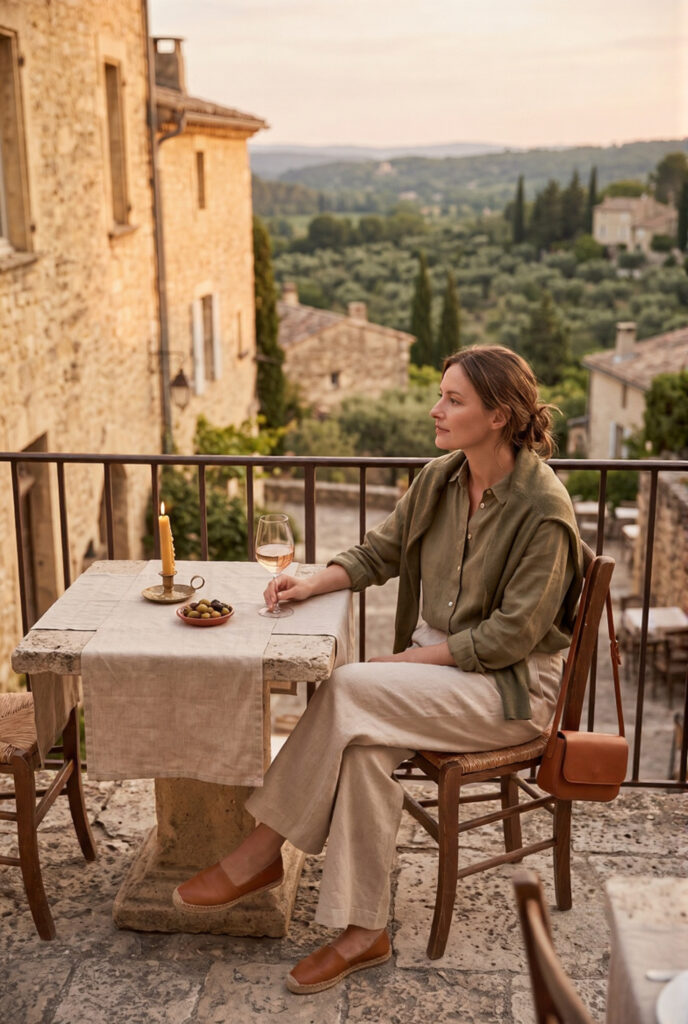
Provence runs on a different clock from the rest of France. The morning market finishes by one. Lunch starts at two and ends when the wine runs out. The afternoon belongs entirely to the shade, to a terrace, and to the particular quality of silence that settles over the Luberon villages between two and five in August. By six the light has gone golden over the sunbaked stone and the evening begins again. You dress for all of this, and you dress for it in linen.
The Provençal aesthetic is not the same as the Riviera aesthetic, which is polished and deliberate. Provence is earthier, more tactile, more connected to the landscape it sits in. The colours come from the landscape directly: the dusty lavender, the terracotta of the roof tiles, the bleached ochre of the stone walls in Roussillon, the grey-green of the olive trees. Nothing glossy, nothing synthetic, nothing that looks as though it was purchased for the trip. The pieces that work here look as though they have been worn before, washed often, and chosen slowly.
The Mistral complicates everything. This is the wind that comes off the Alps and down through the Rhône valley with enough force to rattle shutters and strip tablecloths. It blows hardest in winter and spring but can arrive in summer without warning. A layer that blocks wind without adding bulk is not optional in Provence. It belongs in the capsule across every season.
The Provence Colour Palette
Lavender Dust
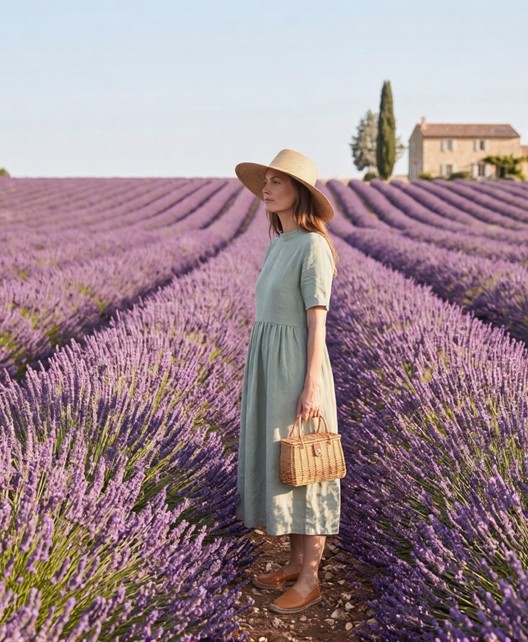
Not the vivid purple of a stock photograph but the real colour of Provençal lavender: a muted, grey-tinted blue-violet that is closer to dusty lilac than to bright purple. Worn in a linen scarf, a washed cotton blouse, or a loose midi dress, it reads as entirely native to the region in a way that no other shade does. The lavender fields peak between mid-June and late July depending on altitude, and in that window this colour, worn in the fields, creates an effect that needs no styling.
Terracotta
The roof tiles of every village from Les Baux to Gordes, the clay pots of the market flower stalls, the ochre-tinged dust of the summer tracks. Terracotta in Provence is not a fashion colour. It is the background colour of the entire landscape, which means a terracotta linen dress or a rust-toned cotton trouser reads as natural here rather than deliberate. The washed, slightly faded version of the colour works better than a bright terracotta, which can look too deliberate against a background that is already that colour.
Provençal Ochre
Roussillon is built from ochre stone that shifts between deep amber and burnt yellow depending on the light and the time of day. This specific shade, warm and golden but dirtier than a true yellow, runs through the Luberon architecture and the dry summer grasslands. In clothing, it works as a trouser or a linen shirt: warm enough to suit the landscape but neutral enough to combine with everything else in the palette.
Warm Stone
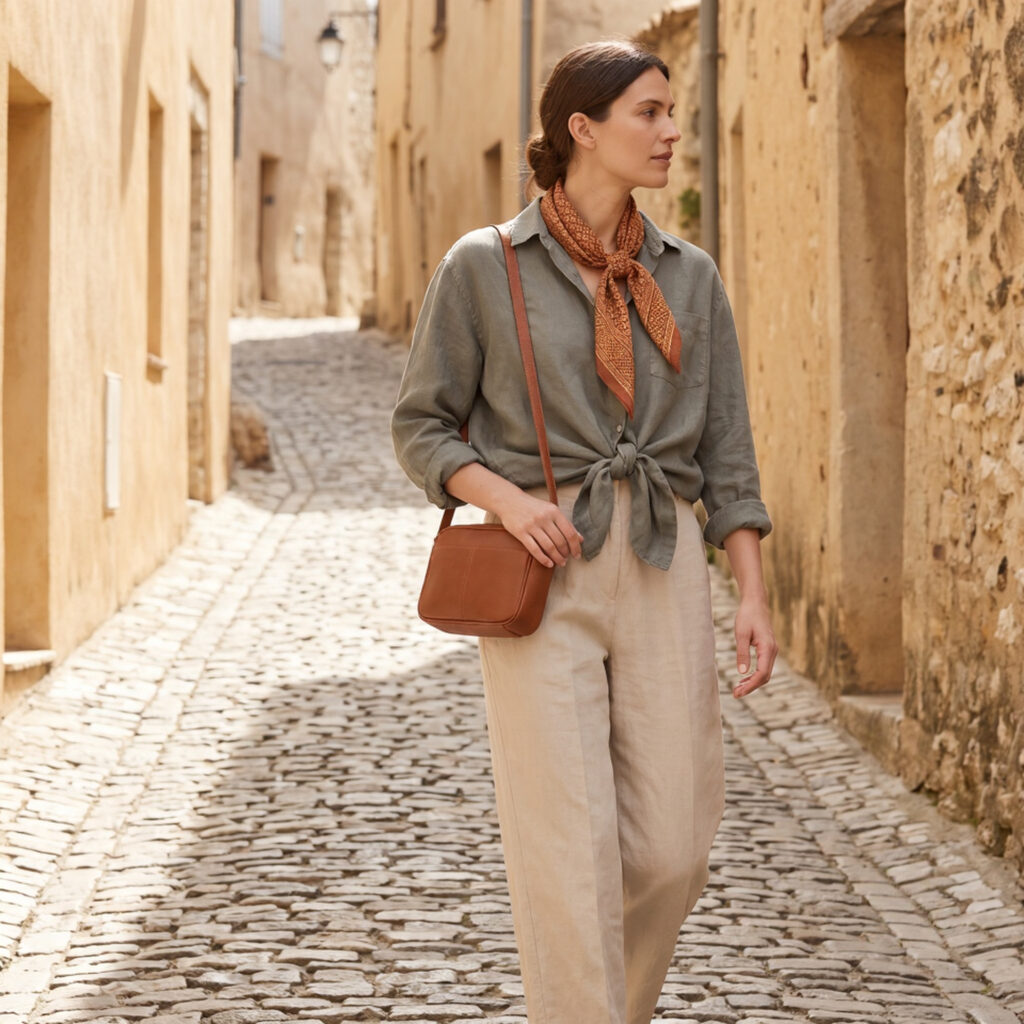
The pale, slightly warm grey-beige of the limestone that Provençal villages are built from. Not as cold as taupe, not as warm as sand. The most versatile neutral in the Provence capsule because it reads as part of the architecture. A warm stone linen trouser or a loose stone-coloured shirt sits against every village wall and every market terrace without asking for attention.
Grey-Green Olive
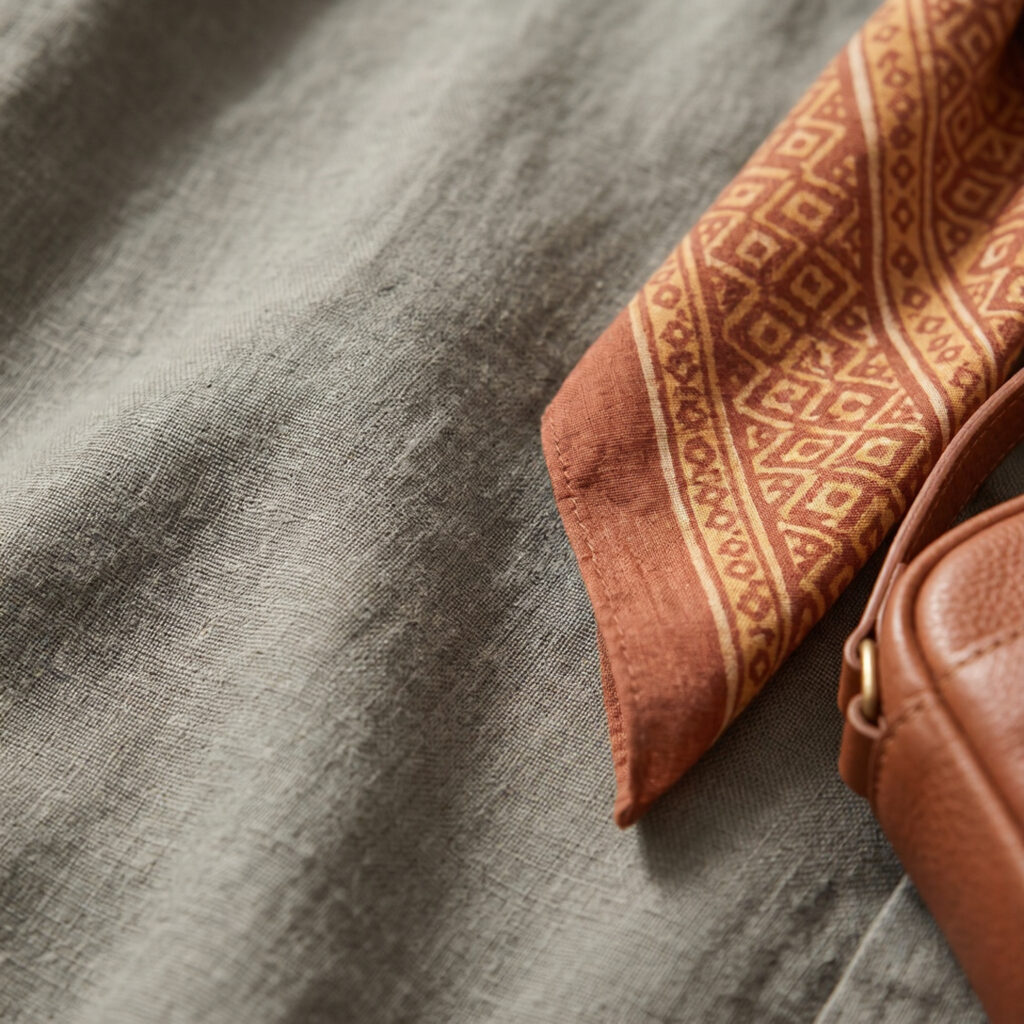
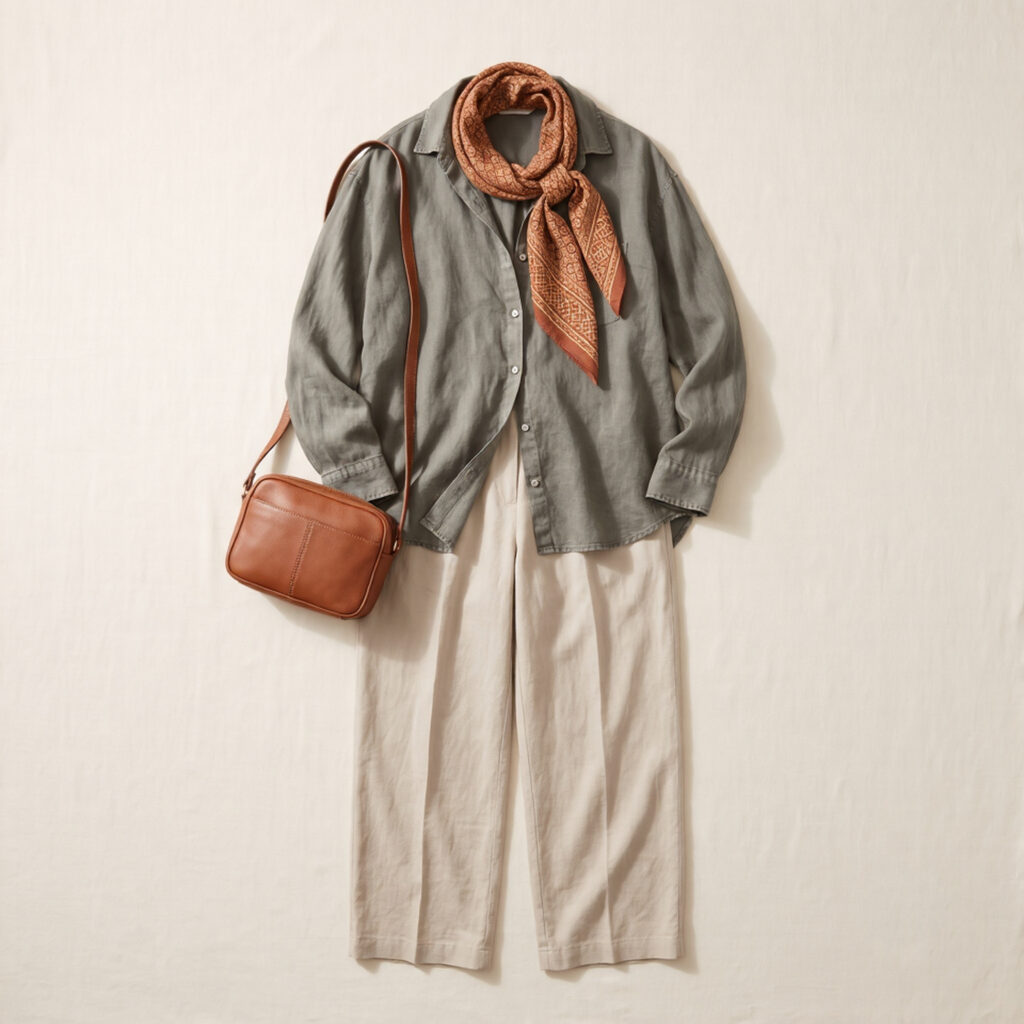
The silver-green of the olive tree is Provence’s most characteristic colour and one of the most wearable. Drier and more muted than the Italian olive, it works in a cotton shirt, a linen jacket, or a lightweight knit for cooler evenings. Against the terracotta and ochre of the landscape it creates the exact colour combination that Provence itself uses.
The Terrain Reality
Provence covers a remarkable range of terrain in a compact area. The market towns, Aix-en-Provence, Arles, Avignon, are flat and paved: easy walking in any flat shoe. The Luberon villages, Gordes, Roussillon, Les Baux-de-Provence, are built on hilltops and rock outcroppings with steep cobbled lanes that require a flat shoe with grip. The lavender fields and the walking tracks through the Alpilles are dry and rocky underfoot. The Camargue is flat, sandy, and wet in the margins.
The flat leather espadrille and the leather mule cover most of what Provence asks of your feet for the warmer months. The espadrille handles the market mornings, the hilltop villages, and the lunch terraces equally. The leather mule with a small block heel is acceptable on the flatter village streets for evenings. From October onwards a leather ankle boot handles the cooler temperatures and the wetter tracks.
The sun in Provence from June through August is direct and sustained. The UV index at midday in the Luberon is comparable to the coast. A wide-brimmed hat in straw or cotton canvas is not an accessory in summer; it is a practical requirement for anyone spending time outdoors. A cotton scarf that can double as a head covering on the most exposed days adds almost no weight and gets used every afternoon.
The Mistral dictates the outerwear. In spring and autumn it can drop the temperature on an otherwise sunny day by ten degrees in under an hour. A lightweight windproof layer, not necessarily waterproof, that packs small and goes over the linen shirt or the knit layer covers the Mistral question across all seasons.
The Provence-Specific Pieces
The Washed Linen Midi Dress
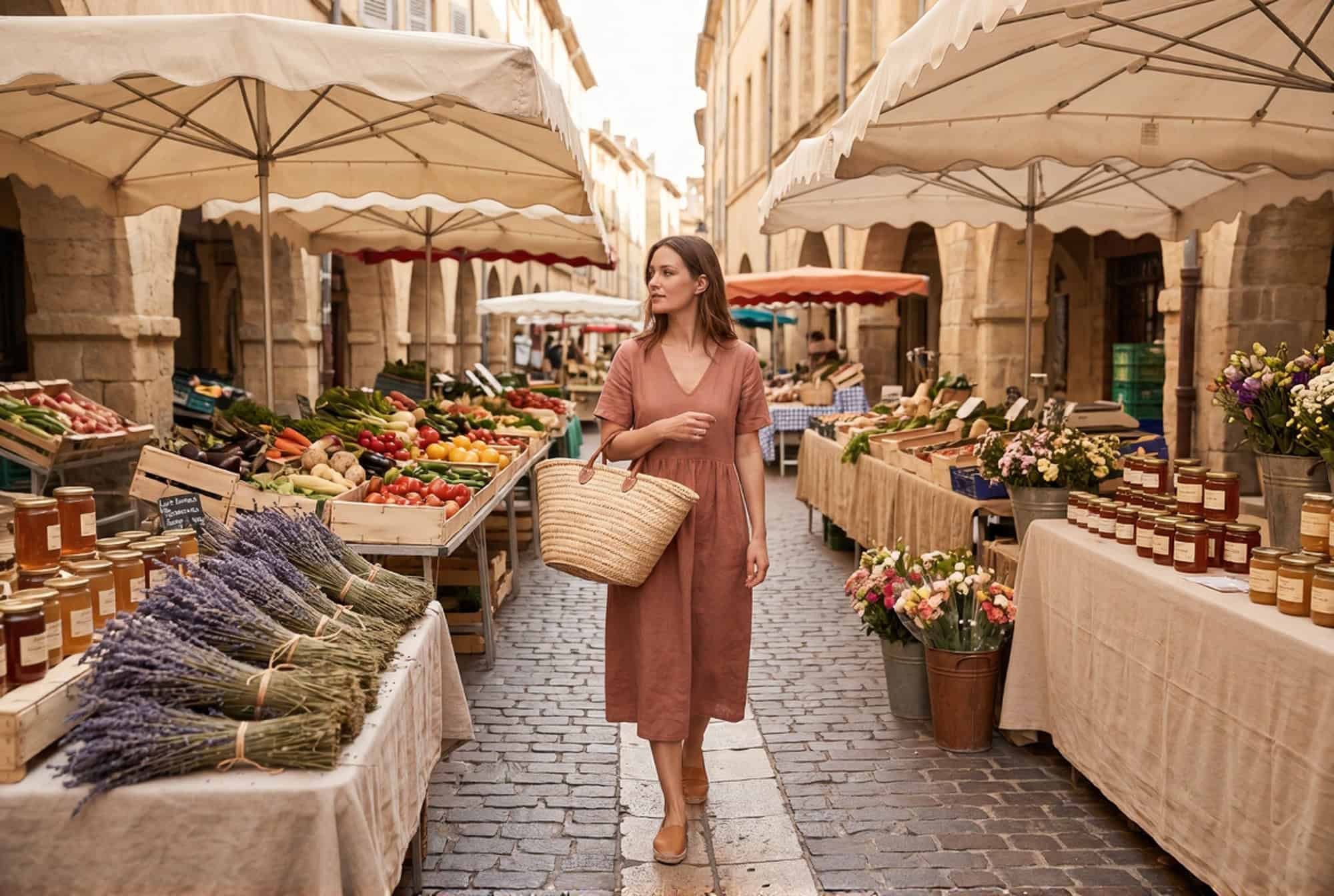
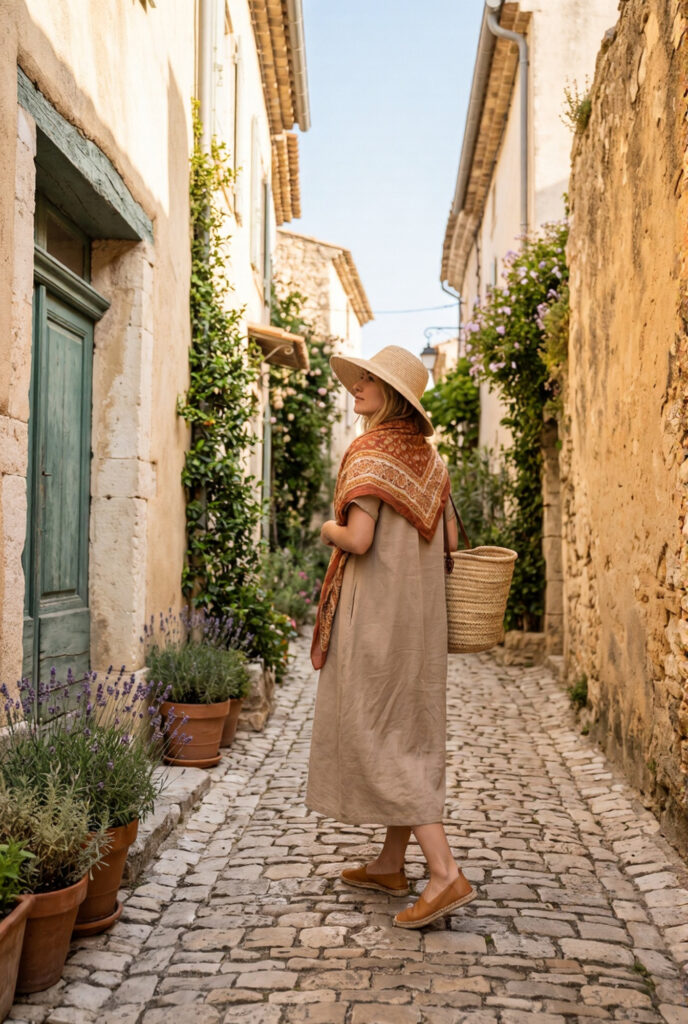
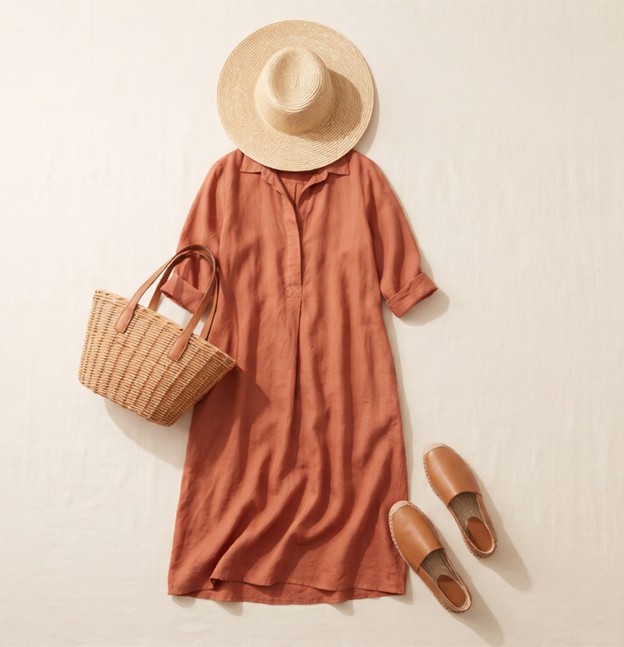
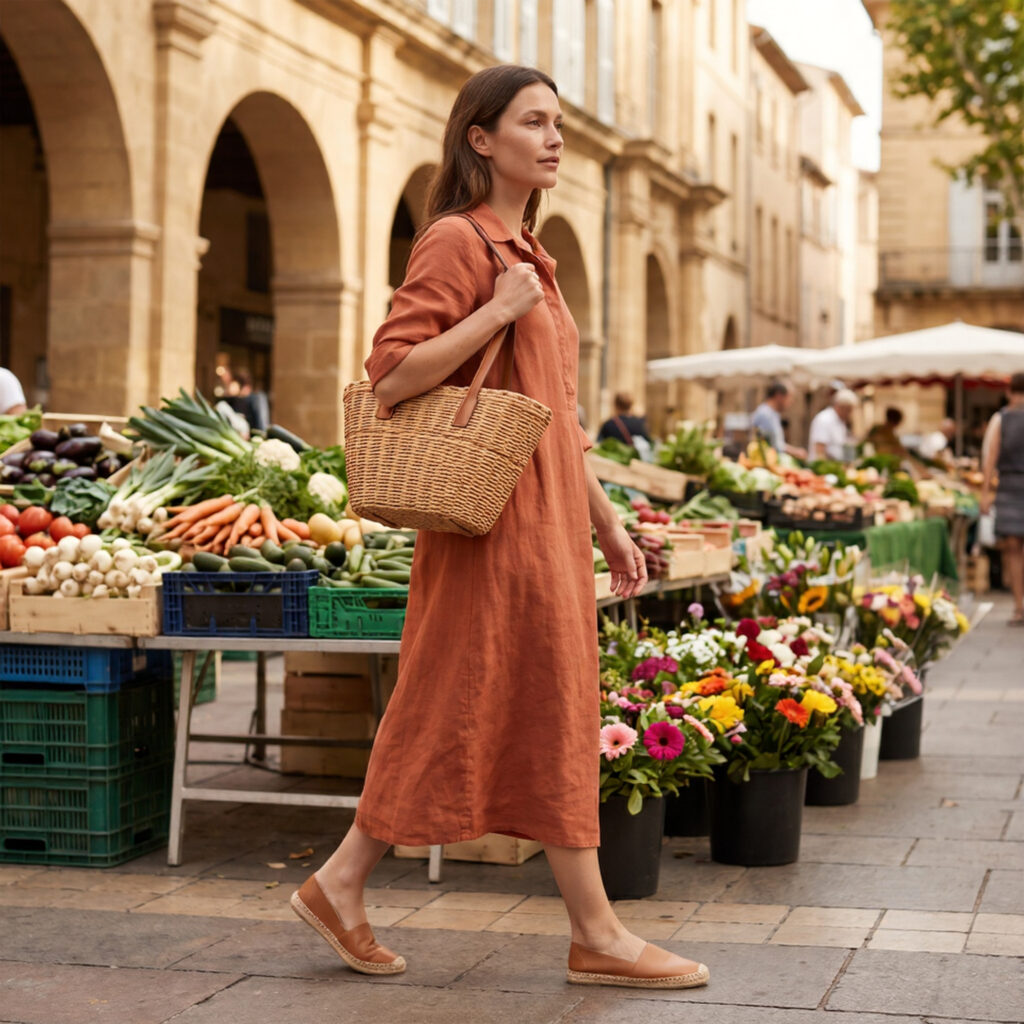
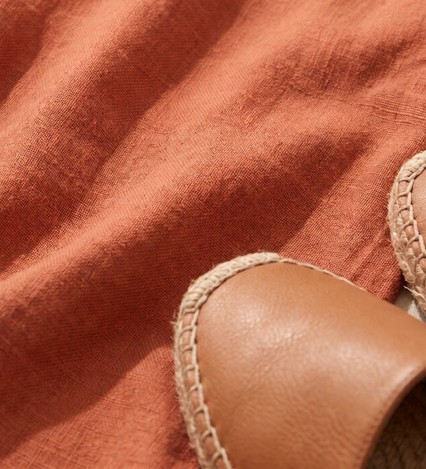
The foundational piece of the Provence capsule and the one that is most specific to this region. Not the crisp linen of the Riviera but a softer, washed version that has lost the stiffness of new fabric and taken on the slightly crumpled quality that Provence rewards. In terracotta, dusty lavender, or warm stone. Midi length for the hilltop village streets and the market mornings where shorter dresses look out of register. This dress worn with flat espadrilles and a basket bag is the Provence outfit at its most correct.
The Flat Leather Espadrille
The shoe of Provence and of the south of France generally. Not the canvas espadrille that disintegrates in the first heavy dew, but a leather-soled version with a jute or rope wedge base of no more than two centimetres. Enough sole to handle the cobbled lanes of Gordes without pain, light enough to carry in a bag as a spare, and correct for every setting from the lavender field to the restaurant terrace. In natural tan, cognac, or the same dusty terracotta as the dress. This is the one piece that separates the Provence capsule from any other France region.
The Loose Linen Shirt in Provençal Colours
In olive, stone, or ochre. Slightly oversized, worn open over a cotton camisole for the market morning, tied at the waist over a linen trouser for the afternoon walk, and worn properly buttoned for the evening. The Provençal linen shirt is not the crisp Parisian version or the beach cover-up of the Riviera. It is something between the two: relaxed, slightly worn-looking, and chosen in a colour that the landscape validates.
The Wide-Brimmed Straw Hat
In Provence in summer, a straw hat is a practical object rather than a styling choice. The sun on an unshaded terrace or a lavender field at noon is strong enough that spending more than thirty minutes in it without head covering produces a headache by mid-afternoon. The hat that works is wide-brimmed enough to shade the face and the back of the neck, structured enough not to collapse in the Mistral, and natural enough in material to suit the basket bag and the linen dress without looking like a deliberate ensemble.
The Wicker or Basket Bag
The Provençal market bag in its truest form. Large enough to carry the morning’s market purchases, a bottle of local rosé, and a change of clothes. Light enough to add nothing to a day’s walking. The wicker and raffia baskets sold at every market in the region are the original; the leather-handled canvas versions available elsewhere do the same job with less local character. This bag does not work for evenings, which is when the small leather crossbody takes over.
The Lightweight Windproof Layer
The piece most often missing from a Provence packing list and most often needed. Not a full waterproof shell but a lightweight nylon or technical cotton jacket that blocks the Mistral without adding real warmth. It packs into a small ball and lives at the top of the bag. In stone, olive, or a washed navy. On the days the Mistral is not blowing it is invisible. On the days it is blowing, it is the most important thing you packed.
The Cultural Register
Provence operates on market time and it is worth understanding what that means before you arrive. The morning market in any Provençal town runs from roughly eight until one. This is not a tourist market; it is where the local population does a significant portion of its food shopping. The dress code at the market is relaxed but not sloppy: a cotton dress or linen trousers, flat shoes, a basket bag. Arriving in very casual holiday wear, shorts and flip-flops, works at the coast but looks out of place at an inland Provençal market.
The long lunch is the most important social institution in Provence. A lunch at a restaurant in the Luberon or the Alpilles runs from two until four and involves multiple courses, local wine, and no particular hurry. The dress code for this lunch is a step above the market morning: a proper dress or a shirt and trouser rather than the beach shorts. The restaurants in the hilltop villages, particularly those in Gordes and Les Baux, have a standard that rewards making an effort.
Religious sites, the abbeys at Sénanque and Silvacane, the churches in Arles and Avignon, require covered shoulders and knees. The Abbaye de Sénanque in particular, still inhabited by Cistercian monks, has a quiet formality that the surrounding lavender fields do not prepare you for. A scarf in the bag handles this across every religious site in the region.
The evening in Provence is quieter than the evening in Paris or on the Riviera. The villages close early. The restaurants in the hilltop towns fill from seven-thirty and are often finished by ten. The dress code is smart-casual: a dress or a proper linen trouser and a good top. Nothing formal, but nothing that reads as beach-adjacent either.
The Fabrics for This Climate
Washed linen is the defining fabric of the Provence capsule and the key word is washed. New linen, stiff and structured, looks out of place in a region where the aesthetic is built on softness, age, and the appearance of things that have been worn and used. Buy linen pieces that have already been washed or garment-washed at the factory: they will have the right quality of drape and the right slightly rumpled texture that Provence rewards. If you buy unwashed linen, wash it twice before the trip and do not iron it.
Cotton is the other primary fabric: 100% cotton in loose weaves for shirts and camisoles, tighter weaves for the windproof layer. Cotton in Provence breathes well in the heat and presses itself slightly in the warm air. The washed cotton blouse in a Provençal colour is as useful as the linen shirt and lighter in the bag.
A thin merino crewneck or a cotton-modal blend cardigan covers the cooler evenings from September through May and the occasional cold Mistral day in summer. Not a heavy knit but something fine enough to fold into a small square and add to the basket bag for an evening that starts warm and cools after sunset.
Avoid synthetics and avoid stiff fabrics. Polyester looks wrong in the landscape and is uncomfortable in the heat. Stiff cotton or raw linen reads as too deliberate in a region where the aesthetic prizes the appearance of ease. Everything in this capsule should move, drape, and breathe.
The One Piece You’ll Wish You’d Brought
A cotton or silk printed scarf in a Provençal print: the small geometric patterns in terracotta, ochre, and olive that the Souleiado and Les Olivades textile houses have been producing in the region since the 17th century. This scarf covers shoulders in religious sites, keeps the Mistral off the neck, doubles as a picnic cloth in a lavender field, and adds the one piece of local specificity that makes the neutral linen capsule feel like it was put together for Provence rather than for France generally. The prints are sold at every market in the region. You will see them everywhere and wish you had brought one from home rather than paying market prices for them.
The One Piece You Won’t Need
A structured leather handbag. The bag logic in Provence is completely different from Paris. The wicker basket and the small leather crossbody cover every situation the region offers. A structured leather tote or a city handbag looks wrong at a Provençal market, gets dusty on the village tracks, and is too large for the small restaurant tables on the terraces of the hilltop villages. Leave it at home and buy a market basket when you arrive. It will cost almost nothing and carry everything.
Planning Your Full France Trip?
This guide covers the specific demands of Provence: the market mornings, the hilltop village lanes, the Mistral, and the long lunch culture that shapes everything about how you dress here. For the full wardrobe picture across all six regions of France, start with the France Packing Guide. If your trip begins or ends on the coast, the French Riviera Capsule Wardrobe covers the shift in register the coast requires. For destination planning in the region, the Provence Travel Guide covers the villages, the lavender season, and everything worth knowing before you go.
Your Provence Capsule: The 12 Pieces
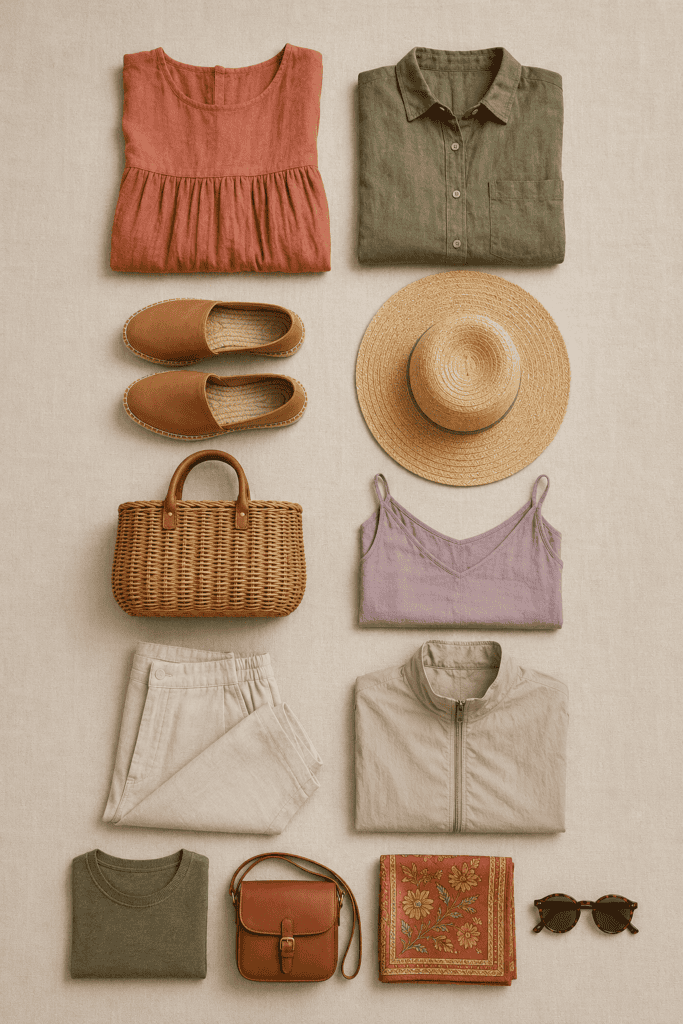
Shop the Provence capsule. Every piece linked below.
- Washed linen midi dress in terracotta, dusty lavender or warm stone —> ANRABESS Womens Summer Dress Ruffle Sleeve
- Loose linen shirt in olive, stone or ochre —> Zeagoo Women Linen Button Down Shirt
- Flat leather espadrille with jute sole in tan or cognac —> CUSHIONAIRE Talisa Espadrilles for Women
- Wide-brimmed straw hat in natural —> Lansome Store Womens Wide Brim Straw Hat UPF
- Wicker or raffia basket bag with leather handles —> Pocardi Women’s Straw Shoulder Bag
- Dusty lavender or stone cotton camisole —> Natural Uniforms Women’s Camisole Tank
- Warm stone wide-leg linen trouser —> Sampeel Wide Leg Pants for Women
- Lightweight windproof jacket in stone or olive —> 33,000ft Store Women’s Lightweight Jacket
- Thin merino crewneck in olive or terracotta —> Amazon Essentials Women’s Lightweight Soft Crewneck Sweater
- Small structured leather crossbody bag in cognac or tan —> EVVE Store Small Crossbody Bags for Women
- Provençal print cotton or silk scarf in terracotta and ochre —> FONYVE Silk Feeling Head Scarf for Women
- Polarised sunglasses in classic frame —> Breaksun Retro Oval Sunglasses for Women
Provence is one chapter of the French wardrobe story. If your trip continues east to the sun-saturated coast of the French Riviera, north to the wine routes and medieval villages of Alsace, the châteaux and cycling routes of the Loire Valley, or the mountain trails of the French Alps, each region has its own capsule guide. For the complete cross-regional packing strategy, visit the Complete Guide to France.