
*This post may contain affiliate links for which I earn commissions.*
The Complete Insider’s Guide to the South of France
The light in Provence is the first thing and then the last thing and the thing that stays with you afterward. Low and golden in the morning, white and fierce at midday, and then in the late afternoon it turns the pale stone villages into something that looks like it was painted rather than built. Van Gogh came here from Paris in 1888 and stayed for over a year. Cézanne spent most of his life painting the same mountain from different angles. When you are standing in it you understand why.
Provence is a large region and a slow one. The distances between the things worth seeing are not enormous but the pace at which you cover them should be. A village market takes a morning when done properly. A lunch that begins at noon does not necessarily end before three. The lavender fields in late June and July need a full morning, not a quick stop on the way somewhere else. If you are in a hurry, come back when you are not.
What to See
The Valensole Plateau lavender fields
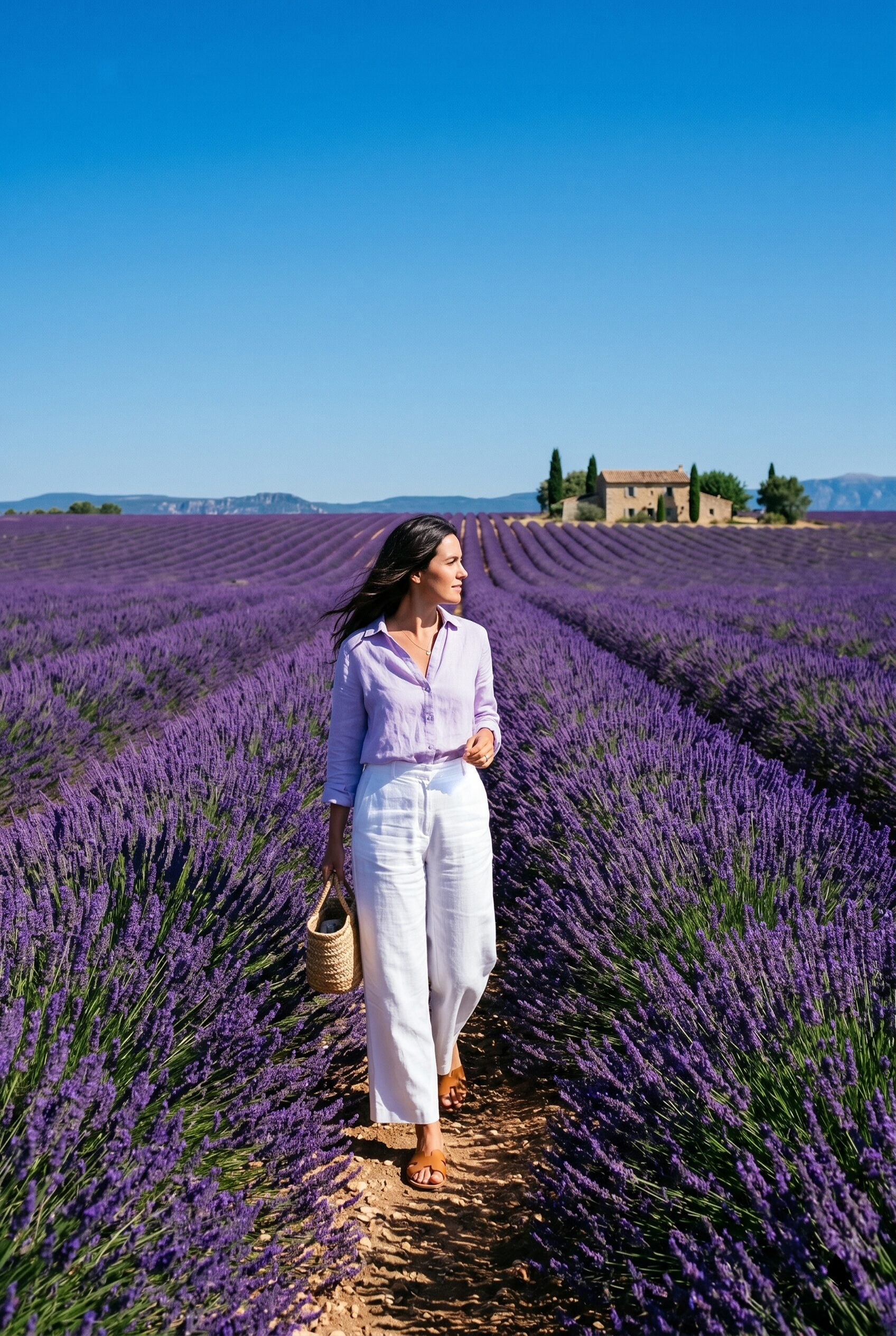
The plateau sits east of the Luberon, a vast flat-topped expanse of farmland where lavender is grown commercially at a scale that turns the landscape purple from late June through July. The rows run to the horizon in every direction. The scent hits you before you see the fields. On a still morning the whole thing looks slightly unreal, even when you are standing inside it.
The bloom window is specific: late June to mid-July in most years. Before late June the fields are still green. After mid-July the harvest starts and the purple goes fast. Check local reports and the Valensole tourism website in the weeks before you go.
The village of Valensole itself is small and quiet with a good weekly market on Wednesday mornings. Drive the D8 road south from the village through the plateau for the best uninterrupted views. Go before nine in the morning. The light is better, the tour coaches have not yet arrived, and the fields are quiet enough to hear the bees.
Gordes and the Luberon villages
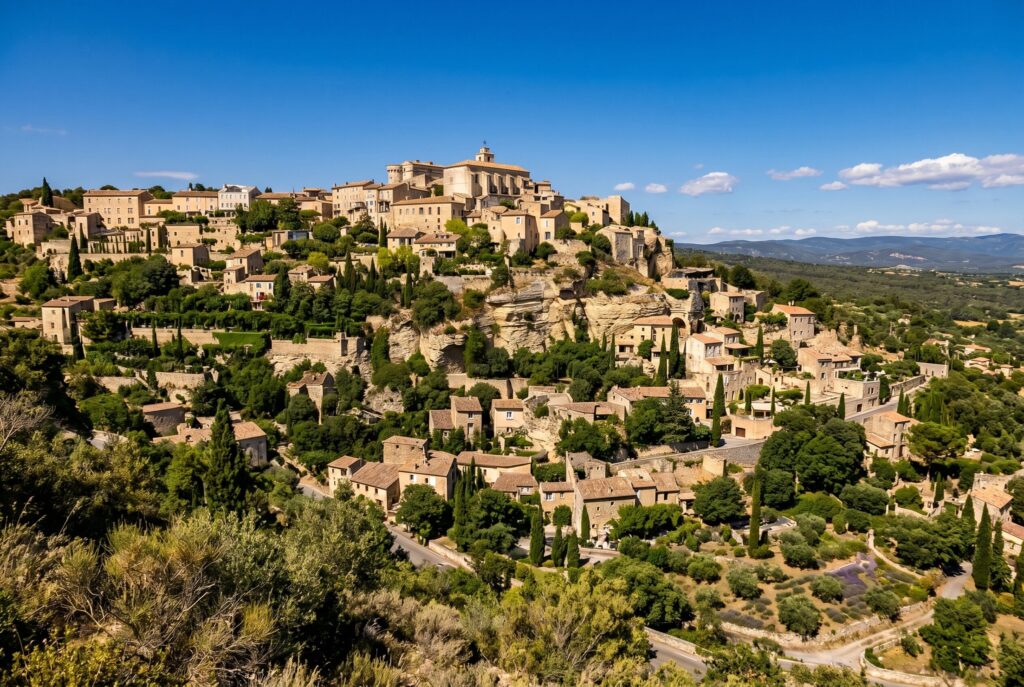
Gordes is the most photographed village in Provence: pale stone houses cascading up a rocky outcrop above the Luberon valley, the village barely distinguishable from the cliff it sits on. Best seen from the D15 road below rather than from inside it, particularly in summer when the streets fill by mid-morning.
The surrounding Luberon villages are each completely different from each other. Roussillon is built from ochre-red rock and surrounded by ochre cliffs, the whole village glowing rust and gold in the afternoon. Ménerbes is quieter and more residential, worth a slow walk and a coffee in the square. Bonnieux has the best view across the valley toward the Luberon ridge. Lacoste, above Bonnieux, is almost entirely owned by the fashion designer Pierre Cardin and has an eerie quality in the early morning when it is deserted.
Give the Luberon villages a full day. The D roads between them wind through cherry orchards and past vineyard terraces and are as much the point as the villages themselves.
The Abbaye de Sénanque
Three kilometres north of Gordes, reached by a narrow road through oak forest. A 12th-century Cistercian monastery still inhabited by monks. In late June and early July the lavender field in front of it is in full bloom: the pale Romanesque stone abbey rising at the end of the rows, the purple running from the road all the way to the facade. It is the image that made this valley famous and it is exactly as good in person.
Come early in the morning or late afternoon. The midday crowds at the height of summer make the approach road impassable. Guided tours of the abbey run at set times and must be booked in advance. The exterior and the lavender field are viewable without a ticket.
The Verdon Gorge
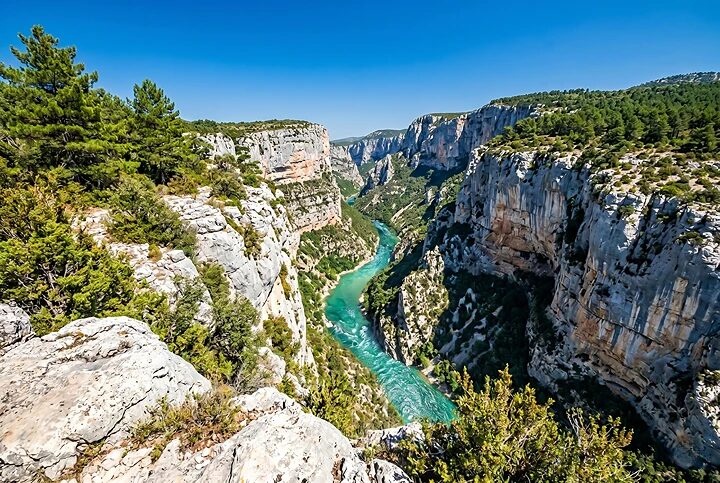
The Gorges du Verdon in the eastern Var is the largest canyon in Europe, about twenty-five kilometres long and up to seven hundred metres deep, the Verdon river running through it in a shade of turquoise that looks digitally altered and is entirely real. The D952 and D71 roads run along the north and south rims and offer viewpoints along their full length.
Drive the Route des Crêtes on the south rim: a single-track road with passing places and vertical drops that needs your full attention and pays you back for giving it. The village of Moustiers-Sainte-Marie above the canyon to the west has a waterfall running through its centre, a star hanging on a chain between the clifftops, and the best ceramics shopping in the region.
What to Do
Go to a morning market
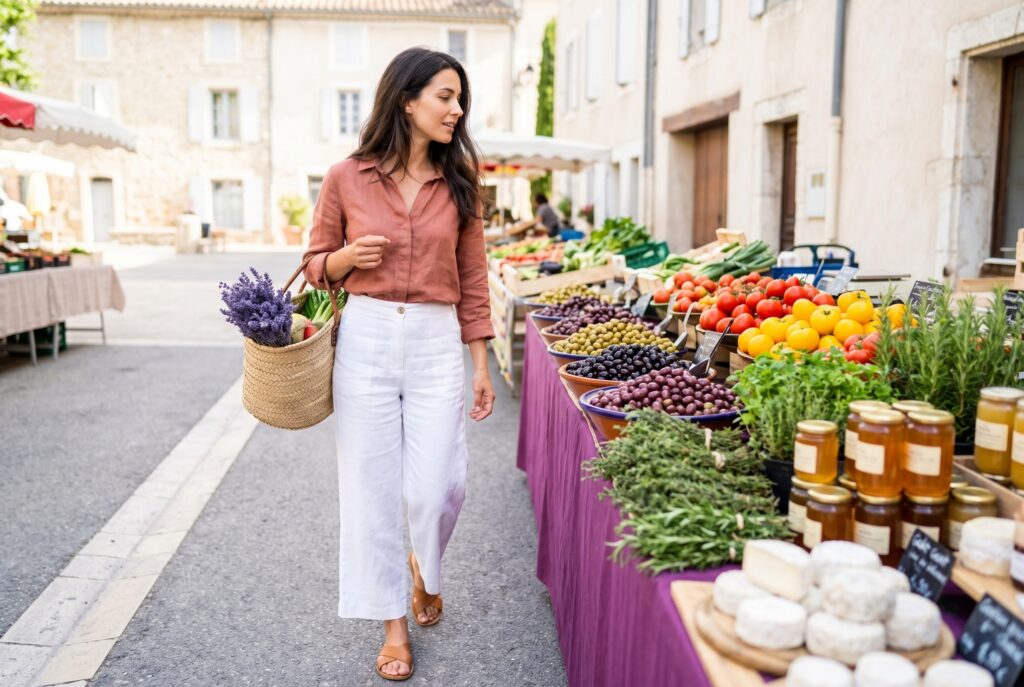
The Provençal market is not a tourist attraction. It is how the region shops, eats, and catches up with itself. Show up early, move slowly, buy things to eat on the spot.
The best markets: Apt on Saturday morning (the largest and most local in the Luberon, running since the Middle Ages), Arles on Saturday, L’Isle-sur-la-Sorgue on Sunday (the antiques market is the largest in France outside Paris), and Aix-en-Provence every day on the Cours Mirabeau. All of them reward being there before ten.
Buy olives, cheese, tapenade, a length of saucisson, fruit from whoever has the shortest queue at the produce stalls. Find somewhere to sit and eat it. This is the whole point.
Drive the back roads
Provence needs a car and the D roads are the reason. The autoroutes get you between cities fast. The D roads are where Provence actually is: winding between villages, past vineyards, through gorges, alongside lavender fields and cherry orchards. Slower than the map suggests and worth every extra minute.
The Luberon loop between Apt, Roussillon, Gordes, Bonnieux, and back to Apt takes about four hours with stops and shows you the ochre cliffs, the hilltop villages, the valley views, and the back roads all in a single day. The drive between Moustiers and the Verdon rim is one of the best in France. The Dentelles de Montmirail above Gigondas, for anyone with an interest in wine, is a landscape of dramatic limestone pinnacles surrounded by some of the best Rhône wine estates in the south.
Spend an afternoon in Aix-en-Provence
Aix is a university town with a dense, elegant historic centre, good restaurants at every price point, excellent food shopping, and the feeling of a place where people are genuinely going about their lives. The Cours Mirabeau, the central boulevard lined with plane trees and fountains, is the social spine of the city. Walk it slowly, drink a coffee at one of the cafés on the shaded side, then explore the streets and squares in the Vieil Aix behind it.
The Atelier Cézanne on the Lauves hill above the city, where Cézanne worked for the last years of his life, is a small and moving museum. The Sainte-Victoire mountain is visible from almost everywhere in the city: the one he painted more than eighty times, rising pale and distinctive above the plain to the east. Book the Atelier in advance.
Aix-en-Provence tourism site: Aix-en-Provence Tourism
Visit a rosé wine estate
Provence produces more rosé than any other French wine region and the best of it bears no relationship to the pink supermarket wine. The wines of Bandol, made primarily from Mourvèdre, and the estates around Les Arcs-sur-Argens and the Var are worth going to find.
Most estates welcome visitors for tastings without advance booking outside the harvest. The Château de Roquefort near Rognac, the Domaine de Rimauresq near Pignans, and the Château d’Esclans near La Motte (producer of Whispering Angel, the most internationally recognised Provence rosé) all offer cellar door visits. Go in the afternoon, stay for a glass in the courtyard, buy a bottle to take back.
Where to Stay
Where you base yourself shapes what kind of Provence trip you have, because the region is large enough that the right base matters.
A village house or mas in the Luberon is what most people are imagining when they decide to come here. A stone farmhouse or a village gîte with shuttered windows and lavender in the garden. The area around Ménerbes, Bonnieux, and Lacoste has some of the best rental properties in the region, available by the week through specialist agencies. Right for longer stays, for people who want to cook, shop at the markets, and use the house as a base rather than a bed.
Aix-en-Provence is the practical hotel base for shorter stays or for anyone wanting to cover more ground including the Verdon and the coast. Central, well-connected by train and road. The Hôtel Cézanne and the Villa Gallici are the two names that come up consistently at the upper end.
Arles is the right choice for anyone interested in the Roman sites, the Van Gogh connection, and the Camargue wetlands to the south. Less polished than Aix, more lived-in. The Hôtel Nord-Pinus on the Place du Forum is the most atmospheric hotel in the city.
Where to Eat
Le Bistrot de Paradou, Paradou
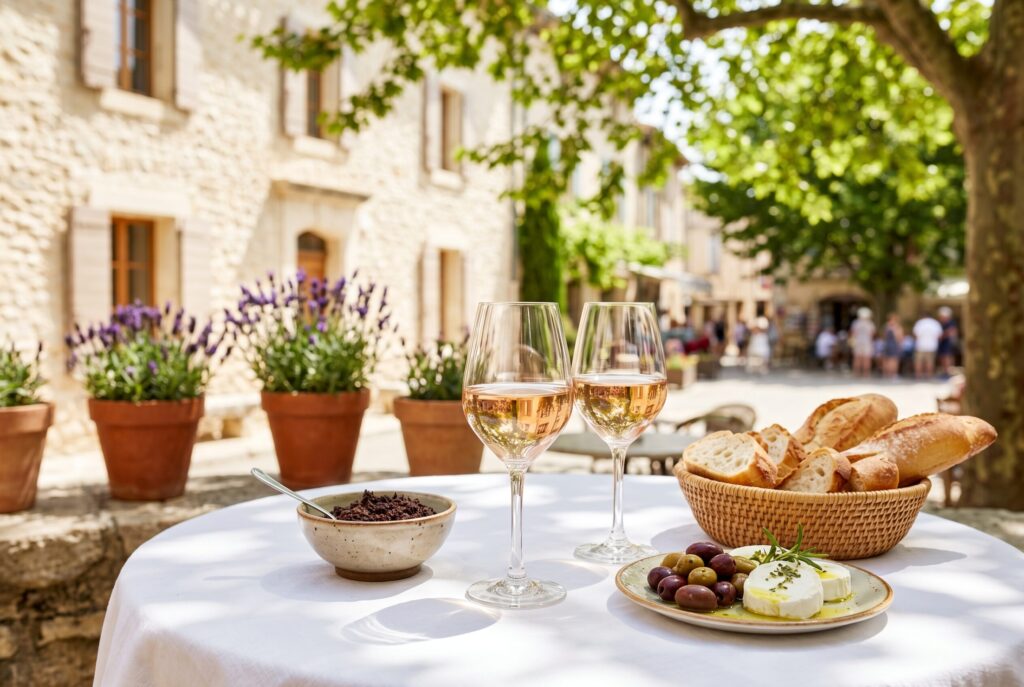
Fixed menu, no choice, communal tables in a village bistro near Les Baux-de-Provence. Lunch only, Monday to Friday. The food changes daily: the aioli, the slow-cooked lamb, the goat’s cheese, the tarte Tatin, whatever came in from the market. Wine is included in the menu price. The room fills by noon. Book ahead and go with no agenda for the afternoon.
Le Café de la Fontaine, La Garde Freinet
Bruno Clément’s café in a small village in the Maures massif above Saint-Tropez. Market cooking, daily menu, strong local following. The terrace looks onto the village square, the plane trees, and the fountain. Lunch only. Book ahead and arrive hungry.
Le Passage, Aix-en-Provence
In the Vieil Aix on the Rue de la Verrerie. An elegant but unpretentious room, a menu built around the Provençal larder, a wine list that goes deep into local estates. The lunch menu is very good value. Dinner needs booking further ahead. The bouillabaisse, ordered the night before, is the reason to go.
Un Dimanche à la Campagne, Oppède
A converted farmhouse in the Luberon with a terrace looking out over the valley. Sunday lunch only, hence the name. Local producers, slow cooking, a rosé list that takes Provence wine seriously. Book well ahead, arrive in time for a glass before the food comes, and plan to stay for the afternoon.
Good to Know
A car is not optional. Unlike the French Riviera where the train covers the main towns, Provence requires a car for almost everything worth doing. The market villages, the lavender plateau, the Luberon loop, the Verdon Gorge: none of this is reachable without driving. Hire a car in Aix-en-Provence, Avignon, or Marseille.
The mistral is real. A cold, dry, powerful north wind that funnels down the Rhône valley and across Provence for days at a time, particularly in spring and autumn. It drops the temperature sharply, dries out the landscape, and makes outdoor dining miserable. When it stops, it leaves the air extraordinarily clear and the light exceptional. Check the forecast.
Lavender timing is specific. Late June to mid-July in most years. Before that the fields are green. After mid-July the harvest starts. If lavender is a priority, plan around that window and check local reports in the week before you go.
Restaurants close on certain days. More so than in Paris or on the Riviera, Provençal restaurants close on Sundays, Mondays, or both, and many close for lunch on weekdays in low season. Always check before you drive to a village specifically for a meal.
Tipping. Not obligatory. Rounding up or leaving five to ten percent at a sit-down meal is generous and appreciated. The fixed-menu restaurants like Paradou include service in the price.
Provence’s official tourism site has seasonal guides including lavender bloom calendars and village market schedules.
Best Time to Go
Late June and July are the lavender months. The fields are at their peak, the weather is reliably hot and sunny, and everything is open. The downsides are real: crowds at the major sites, high prices everywhere, and heat in July that makes anything outdoors after eleven in the morning hard work.
April, May and September are the better alternatives for most people. Spring brings a green and flowering landscape before the summer heat. The Luberon villages are quieter, the roads driveable, and the light is some of the best of the year. September brings the harvest, the vendange, the vineyards turning gold and the rosé estates at their most active.
The truffle season starts in October and spreads into Provence through the month. The summer crowds are gone, the light is low and golden in the way that makes Cézanne’s Sainte-Victoire paintings make immediate sense, and many restaurants run truffle menus from October onward. It is a good month to come.
Winter in Provence is cold, particularly when the mistral blows, and many of the smaller village restaurants and gîtes close from November to March. Aix and Avignon stay open and are worth visiting year round.
Read Next
Provence has its own wardrobe logic: washed linen, soft silhouettes, nothing too structured. The Provence capsule post is coming soon with the full breakdown for the market mornings, the lavender fields, and the long lunches under the plane trees.
For the full France wardrobe picture across every region, the Complete Guide to Packing for France is where to start.
Already done Paris or the Riviera? The Paris Travel Guide and the French Riviera Travel Guide are both live on The Capsule Trip.
Planning what to pack for Provence? The Provence Capsule Wardrobe post is coming soon. In the meantime, the Complete Guide to Packing for France covers the core pieces that work across every French region.