
*This post may contain affiliate links for which I earn commissions.*
Quick Summary
Pack a 12-piece Paris capsule anchored by a Breton stripe marinière, a white cotton poplin shirt, and slim navy trousers that carry a Marais morning into a ten o’clock dinner. A camel trench coat and a tan leather loafer handle the cobblestones and the unpredictable four-season weather. Skip the single formal dress. A blazer over a silk camisole covers the evening standard more efficiently.
The City Portrait
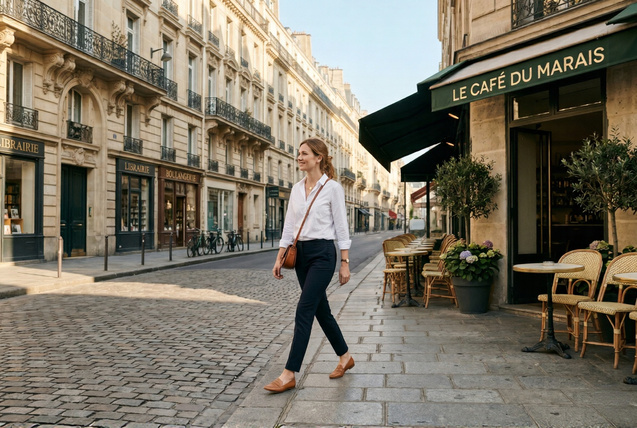
Paris has a dress code that is not written anywhere and not enforced by anyone, but is understood by everyone who lives there. It is built on a single governing idea: you dress to show that you chose these pieces deliberately, not that you grabbed whatever was clean. The standard is not high in the sense of expensive. It is high in the sense of considered. A well-cut white shirt worn with dark trousers and a good flat shoe is more correct in Paris than a new outfit that doesn’t quite fit.
The city covers a remarkable range of settings in a single day. Morning in a museum. Lunch on a café terrace. An afternoon in the Marais or Saint-Germain, walking without a particular destination. An evening that starts with wine and ends at a restaurant table at ten. The Paris capsule wardrobe needs to move across all of those registers without asking you to go back to the hotel and change.
It also needs to handle the cobblestones. Paris is a beautiful city built on stone, and the streets, particularly in the historic neighbourhoods, are hard on feet and on shoes with thin soles. The footwear decisions in this capsule are made with that reality in mind first and aesthetics second. Fortunately the two rarely conflict.
The Paris Colour Palette
Haussmann Stone
The pale warm beige of the limestone facades that line almost every street in the historic city. It is the colour that makes Paris look golden in the late afternoon light and pale silver in the morning. Wearing this tone, in a camel coat or a stone-coloured trouser, means you read as part of the landscape rather than in contrast to it. It is the most Parisian of all the neutrals precisely because it is specific to the city’s architecture.
Ink Navy
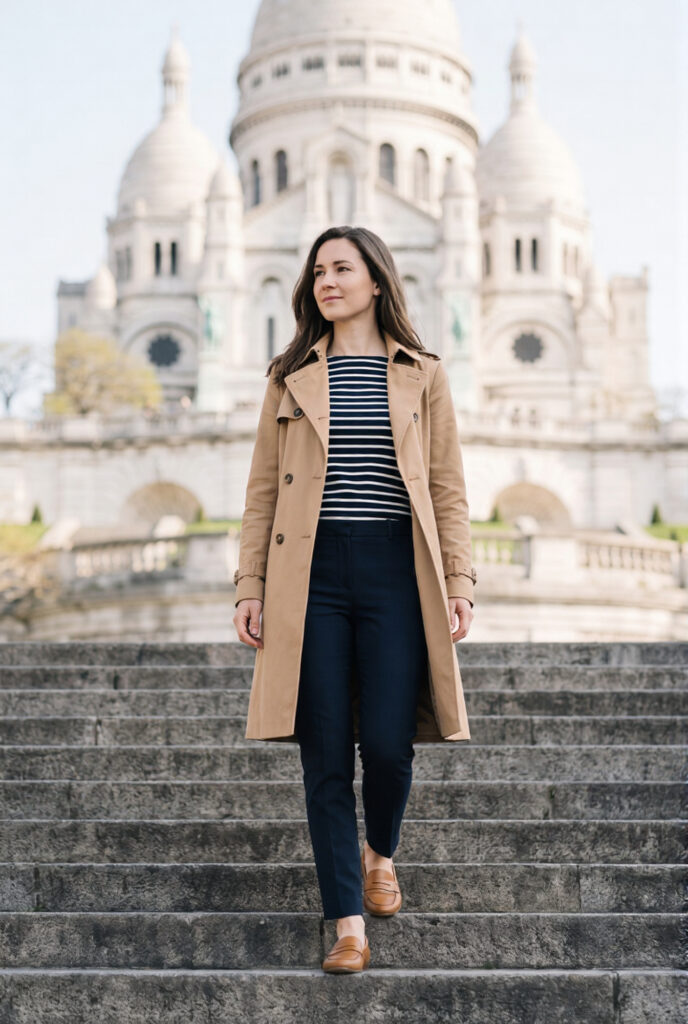
Not a bright primary blue but the deep, near-black navy of the French sailor’s uniform, the marinière, and the classic Parisian blazer. This is the anchor colour of the Paris wardrobe. It works from a morning museum visit in a slim trouser to an evening dinner in a well-cut jacket. It ages well in good fabric and pairs with every other colour in this palette.
Chalk White
Crisp, clean, and slightly warmer than a cold white. The colour of a good cotton poplin shirt pressed flat or a fine-knit top worn with dark trousers. In Paris, white is worn year-round rather than just in summer. It creates the contrast that makes a simple outfit look deliberate.
Camel
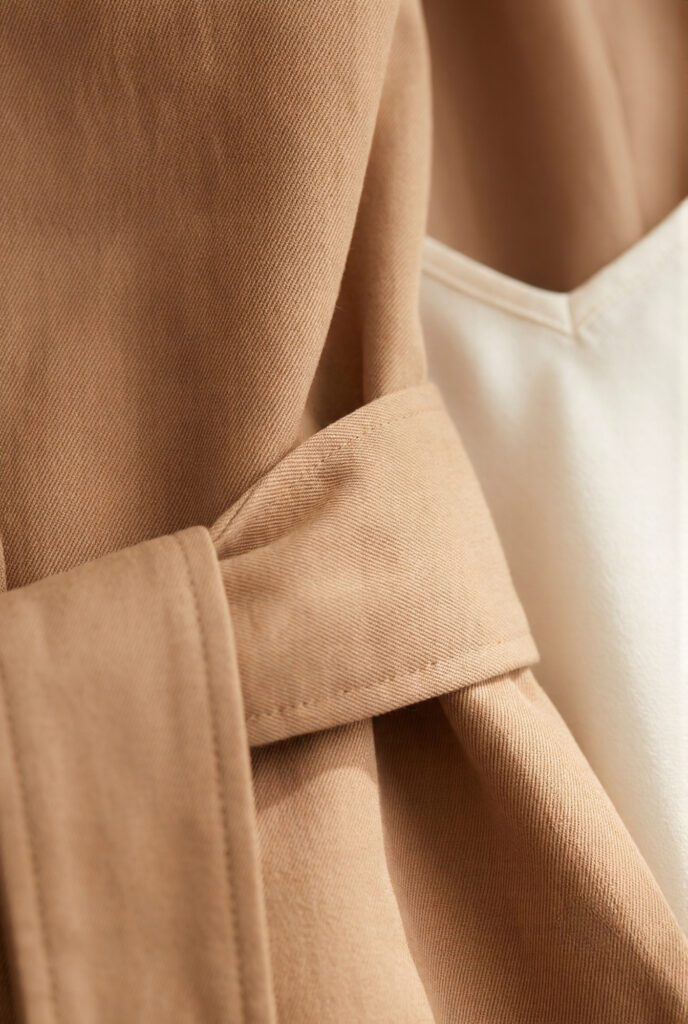
The colour of the classic trench coat and the leather loafer. Warm, versatile, and impossible to leave Paris without seeing on someone who looks exactly right. A camel coat over anything dark reads as Parisian without trying to. A camel leather bag over a white shirt and navy trouser is the formula at its most straightforward.
Muted Terracotta
Used sparingly and with restraint. A terracotta scarf over a navy coat, or a brick-red silk blouse for an evening. The Parisians borrow this colour from the café awnings, the old painted shop fronts, and the occasional burst of it in a Haussmann building’s ironwork. It adds the warmth that an all-neutral palette sometimes needs.
The Paris Terrain Reality
Paris is a walking city. The distances between the major sights and neighbourhoods are walkable, and the best version of any Paris day is the one where you put the metro map away for a few hours. The Louvre to the Palais Royal is a ten-minute walk. The Marais to Saint-Germain crosses the Île de la Cité and takes forty minutes at a comfortable pace. The Montmartre climb adds another dimension.
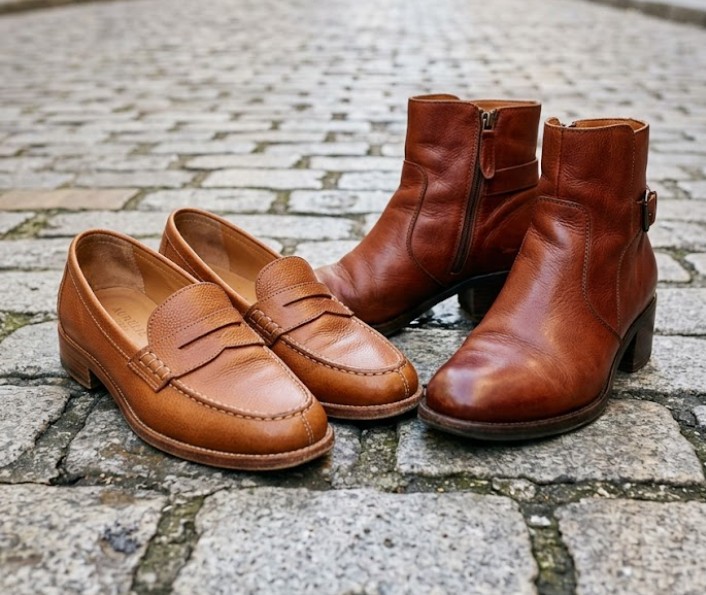
The streets in the historic districts, particularly the Marais, the Latin Quarter, and Montmartre, are cobblestone. Some of them are steeply inclined. A heel of any real height becomes painful by early afternoon. A thin-soled sneaker becomes painful by mid-morning on the oldest streets. The leather loafer and the leather ankle boot are the two shoes in this capsule because they are the two that handle Paris most honestly.
The weather in Paris runs through all four seasons with genuine conviction. Summer is warm and occasionally very hot. Autumn is mild and the finest season visually. Winter is cold and grey and beautiful in a way that photographs poorly but feels right in person. Spring is unpredictable in the specific way that northern European springs are unpredictable: fifteen degrees and raining on Tuesday, twenty-two and sunny on Thursday. The capsule for three seasons is in this post. For deep winter, add a heavyweight wool coat and thermal base layers.
The Paris-Specific Pieces
The Marinière
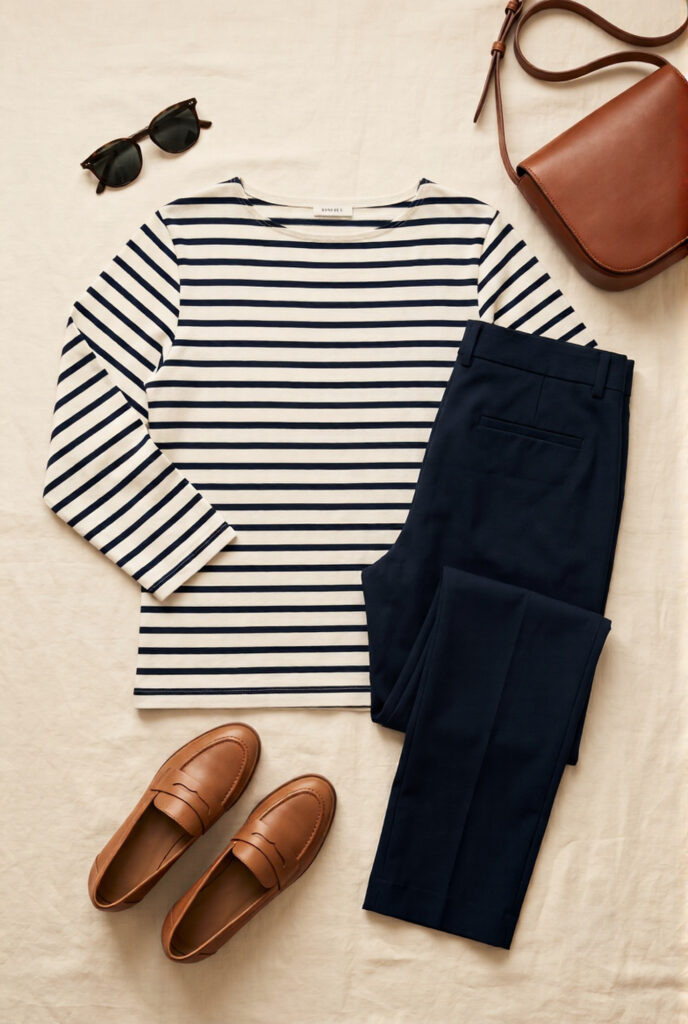
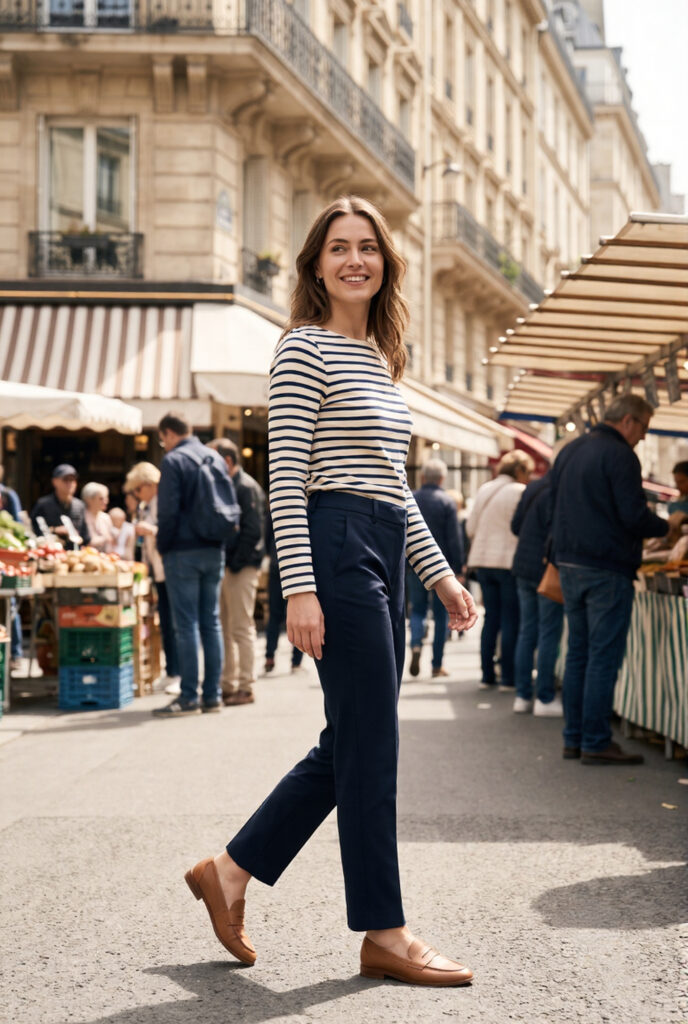
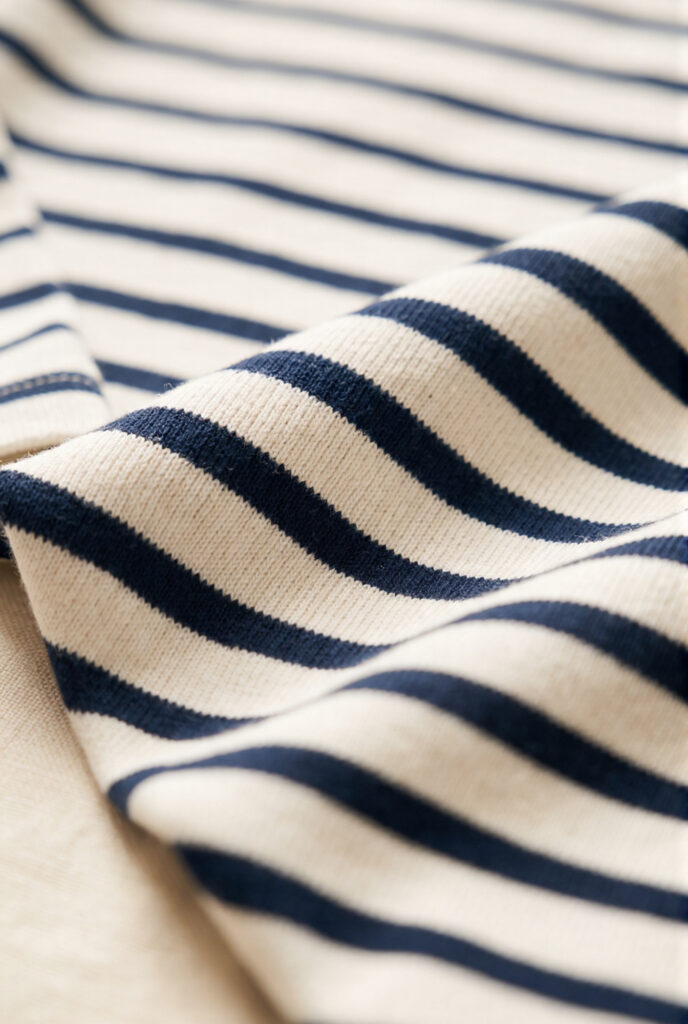
The Breton stripe top is the single piece most associated with French style and the one that earns that association most honestly. Worn in Paris since Coco Chanel borrowed it from the sailors of Brittany in the 1910s, it is a casual-to-smart pivot piece that works from a café breakfast to a boat lunch on the Seine to an afternoon in any museum in the city. The best version is a tight-knit cotton with precise navy stripes on écru or white. Look for a crew or boat neckline, bracelet-length or full sleeves, and enough body weight that it does not go limp when tucked into trousers. This is not a piece where cheaper is fine. The quality of the fabric makes the outfit.
The White Cotton Shirt
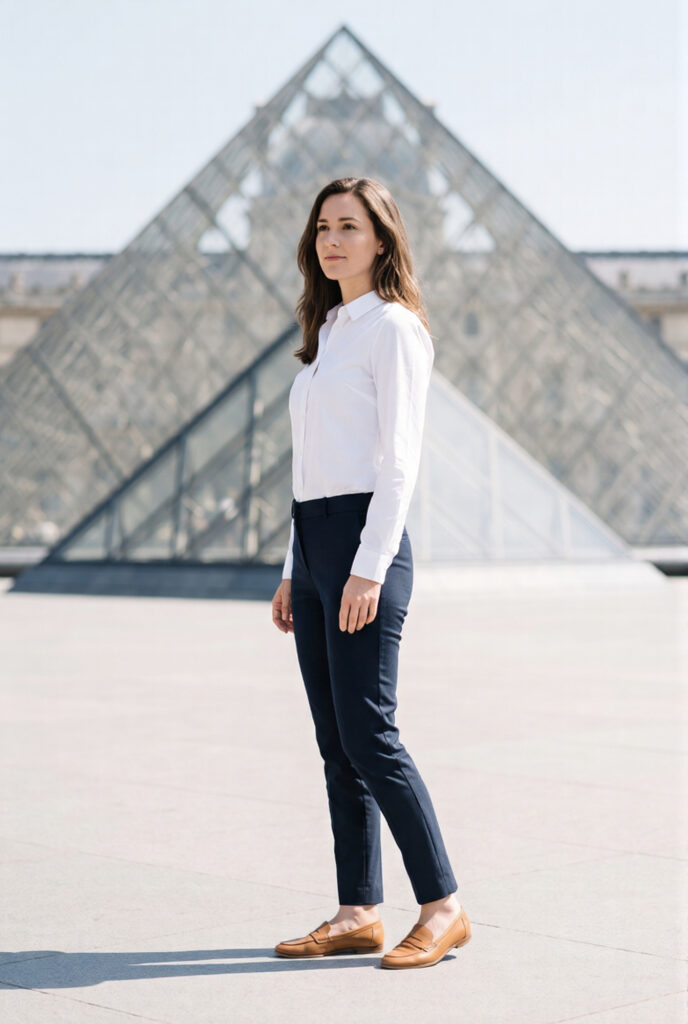
The foundational piece of the Paris wardrobe and the one that does the most work. Worn tucked into dark trousers with sleeves rolled to the forearm for the museum morning. Worn open over a fine-knit camisole for the café afternoon. Worn buttoned and slightly pressed for the dinner. The key is the cut: not a stiff office shirt but something with a slightly relaxed collar, a hem length that works half-tucked, and a poplin or chambray weight that looks clean after a day’s wear.
The Slim Dark Trouser
Slim-straight, not skinny and not wide. Sitting at or just below the natural waist, finishing cleanly at the ankle. In dark navy or charcoal. This trouser goes from the morning Louvre visit to the evening wine bar without changing and without looking like it is trying too hard to cover both. The ankle length matters: too long and the cobblestones will destroy the hem. The fabric matters: a cotton-wool blend or a technical fabric that holds its shape after a day of walking performs better than pure cotton, which can pill and sag.
The Unstructured Linen or Cotton Blazer
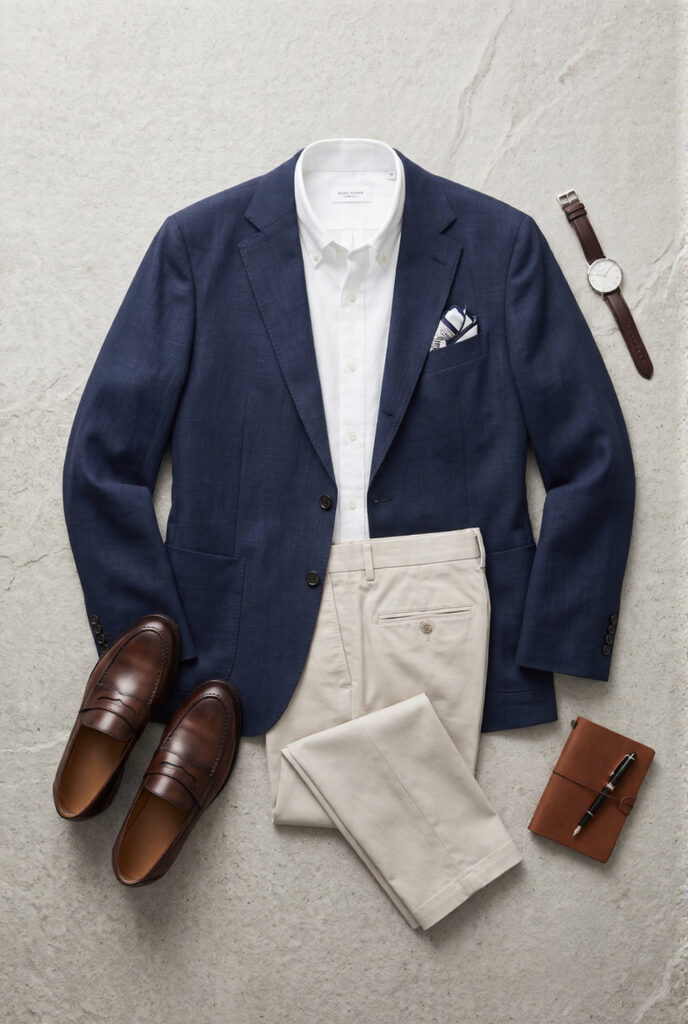
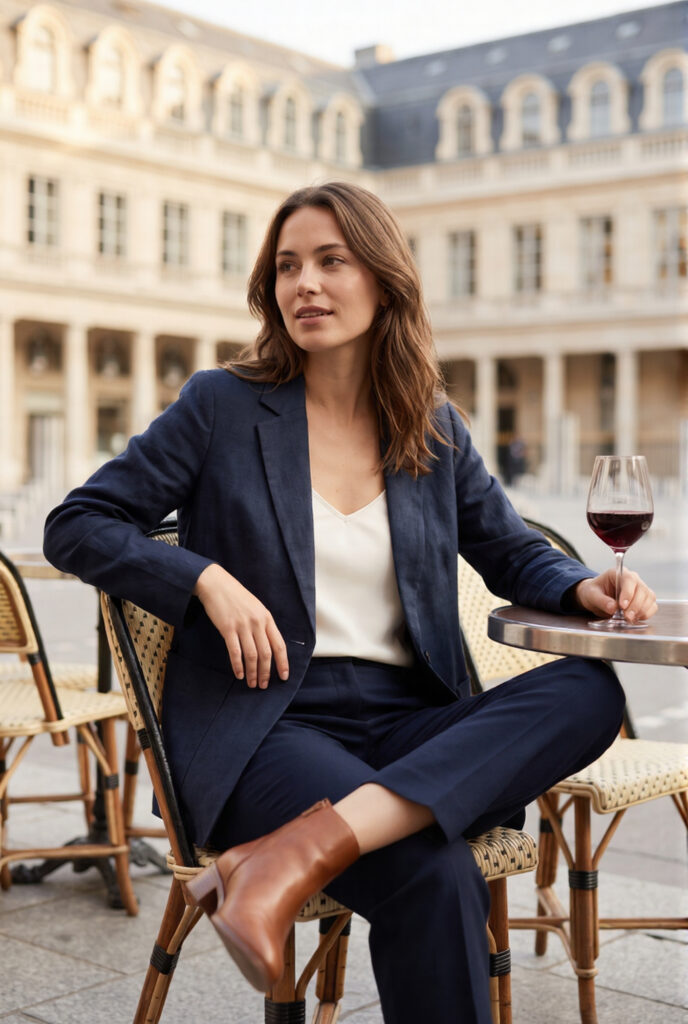
Not a formal blazer but an unstructured version in linen, cotton, or a light wool blend. In navy or camel. This is the piece that elevates the white shirt and trouser from daytime to evening, from museum to restaurant. In Paris, where the dress code for dinner is real but not formal, the blazer covers the gap between a casual afternoon outfit and something that reads as evening without requiring a full change. It packs well rolled, takes up little space, and goes over everything in the capsule.
The Camel or Tan Trench Coat
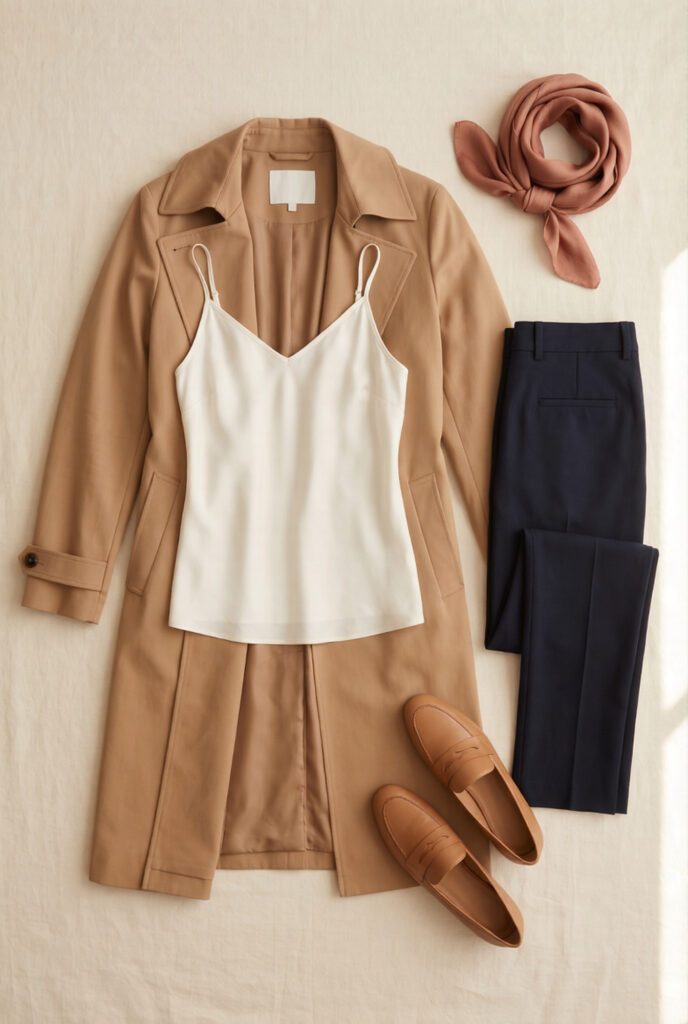
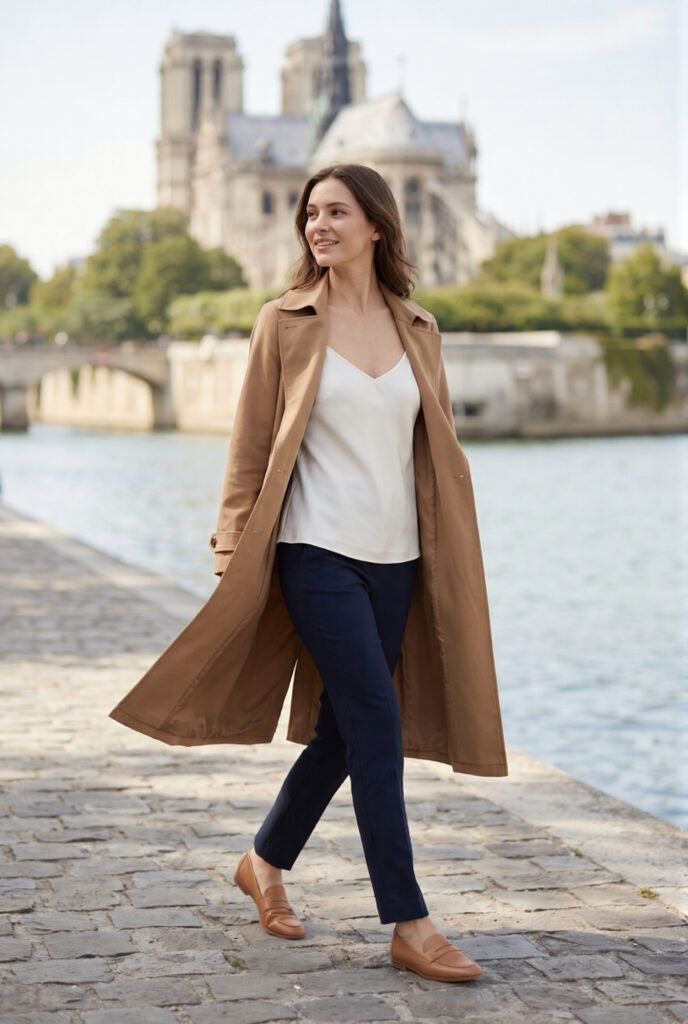
The trench coat is the outerwear anchor of the Paris wardrobe and has been since the early 20th century. The version that works for travel is unlined: a cotton-nylon blend in classic camel or khaki, light enough to fold into the top of a carry-on. It goes over the marinière and dark trousers, over the white shirt and blazer, over the knit dress. In spring and autumn it handles everything the Paris weather throws at you. In summer it lives in the bag and comes out for cool evenings. The silhouette should be classic: a proper collar, a belted waist, clean sleeves.
The Fine-Knit Layer
A merino crewneck or a thin cashmere cardigan in chalk white, camel, or ink navy. This is the layer that goes between the shirt and the blazer on a cool morning, under the trench coat when the temperature drops, and on its own in the evening when the weather is mild. Merino is the better travel choice: it regulates temperature, resists odour, and does not wrinkle. A cashmere cardigan adds more weight to the bag but the warmth it delivers justifies it.
The Cultural Register
Paris runs on invisible effort. The city’s most stylish inhabitants look as though they dressed without thinking. This is not true. They thought considerably. The skill is in making the thought invisible, which requires choosing pieces that fit well, work together without coordination, and look as though they have been worn before. Nothing looks more out of place in Paris than an outfit that is visibly new and visibly assembled for the trip.
The specific moments where the dress code matters most: dinner. Paris restaurants that would register as casual in New York or London expect a Paris standard of evening dress. Long trousers, a clean shirt or blouse, shoes rather than sneakers. This applies equally in a neighbourhood bistro in the Marais and in a more formal restaurant near the Palais Royal. Showing up in activewear or beach clothes reads as indifference, and the service reflects it.
Museums are neutral territory for dressing: you can wear almost anything. The exception is that very casual dressing, shorts, flip-flops, beach cover-ups, tends to attract the mild impatience of museum staff who have been dealing with tourist groups since nine in the morning. A step above very casual is all that is required.
The café is the most forgiving setting. Parisians eat breakfast and take coffee in their morning walking clothes. The afternoon café is similarly casual. The evening café or bar, from seven onwards, trends toward the same standard as the restaurant: a step up from whatever you wore during the day.
The Fabrics for Paris
Cotton and linen are the base fabrics for spring and summer in Paris. The city is warm rather than hot in most summers and the natural fibres keep pace with the temperature without the synthetic shine that looks wrong in the city’s light. A cotton poplin shirt that can be pressed in thirty seconds with a travel iron is more useful than a cotton-blend shirt that wrinkles irreversibly.
Merino wool is the most useful single fibre for the Paris capsule across all three seasons. It regulates body temperature in spring and autumn when the day can start cold and warm considerably by noon. It does not wrinkle. It resists odour for multiple wears between washing. A thin merino crewneck layers invisibly under a shirt or blazer and adds meaningful warmth without bulk.
Wool-blend trousers hold their shape better than pure cotton trousers over a full day of walking and sitting. If the trouser in this capsule has any give and any structure, a wool-cotton or wool-polyester blend delivers both. Pure linen trousers wrinkle within an hour on a warm day and require a tolerance for that wrinkle that not every setting in Paris rewards.
The trench coat should be an unlined cotton-nylon or cotton-polyester blend. A fully lined trench is too warm for Paris spring and autumn and too bulky for travel. The unlined version handles wind and light rain equally and packs flat into the top of a carry-on.
The One Piece You’ll Wish You’d Brought
A silk or satin camisole or shell top in chalk white or ivory. Paris evenings call for something with a different quality from the daytime shirt, and a fine silk camisole under the blazer, or on its own with the dark trouser, covers the gap between the day look and something that reads as genuinely evening. It takes almost no space in a bag, weighs nothing, and transforms the outfit in a way that a cotton shirt, however well chosen, does not. This is the piece that most people leave out and miss from the second evening onwards.
The One Piece You Won’t Need
A formal dress packed specifically for one dinner. Paris does not require formal dressing in the sense that a formal dress implies. What it requires is a step up from daytime casual, which the blazer and trouser combination in this capsule already handles. A dress that needs specific shoes, a specific bag, and a specific undergarment takes up significant space and delivers one outfit. The blazer over a silk camisole with dark trousers delivers a dozen variations of the same elevated evening look. Leave the formal dress at home.
Planning Your Full France Trip?
This guide covers the specific demands of Paris: the cobblestones, the café-to-dinner range, and the standard that the city quietly expects. For the broader wardrobe picture across all six regions of France, visit the France Packing Guide: What to Pack for Every Region. If your trip continues south to the sun-saturated coast, the French Riviera Capsule Wardrobe covers the shift in register that the coast requires. For destination planning beyond the wardrobe, the Paris Travel Guide covers what to see, where to eat, and everything worth knowing before you go.
Your Paris Capsule: The 12 Pieces
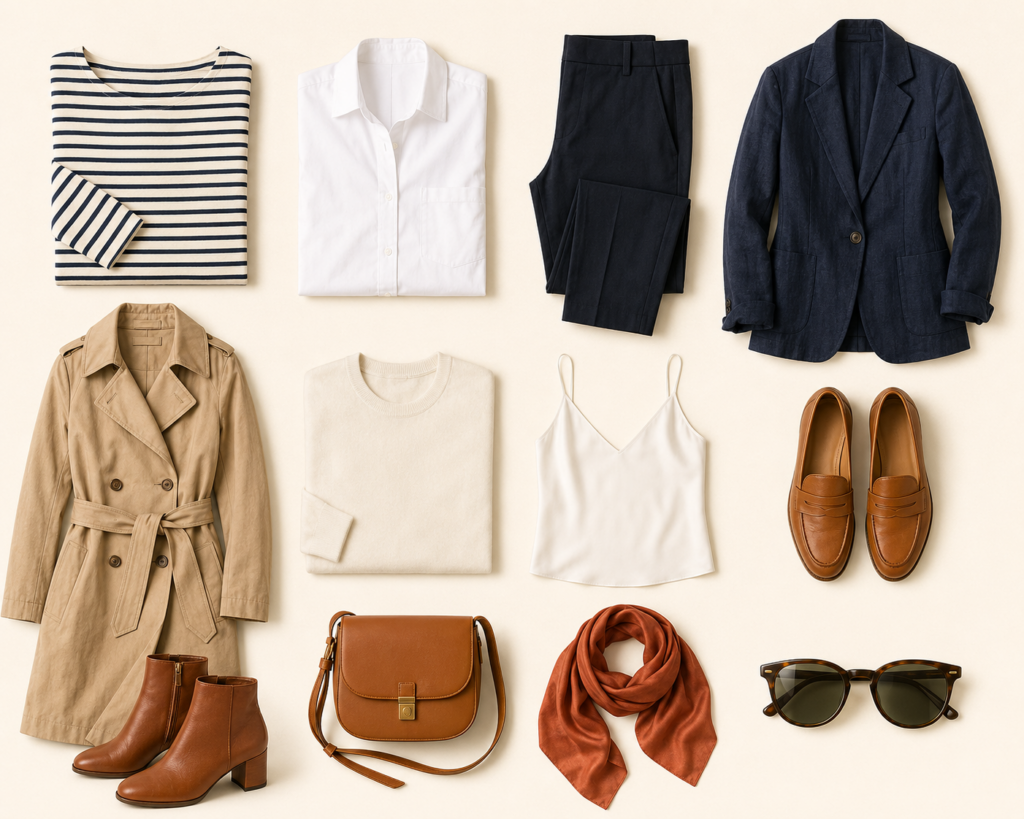
Shop the Paris capsule. Every piece is linked below.
Affiliate note: links below are Amazon US affiliate links. If you buy through them, I earn a small commission at no extra cost to you.
Shop here:
- Breton stripe marinière top in navy and écru — LilyCoco Womens Striped Long Sleeve Tops
- White cotton poplin shirt — Mutitop Store Womens Button Down Cotton Shirts
- Slim-straight dark navy trouser — SATINATO Women’s Straight Stretch Pants
- Unstructured linen blazer in navy or camel — Cicy Bell Womens Casual Blazers
- Classic camel trench coat, unlined — NANJUN Women’s Double-Breasted Trench Coat
- Fine merino crewneck in chalk white or camel — Arach&Cloz Women’s Wool Blend Crew Neck Casual Sweaters
- Silk or satin camisole in ivory or white — Ekouaer Womens Silk Satin Camisole Tank Tops
- Tan leather loafer with rubber sole — KORDAL Women’s Comfortable Leather Loafers
- Leather ankle boot, flat or very low heel — Rockport Women’s Carly Bootie Leather
- Structured cognac leather crossbody bag — WESTBRONCO Crossbody Bags for Women
- Silk or modal scarf in camel, terracotta or navy — PoeticEHome 100% Mulberry Silk Scarf
- Polarised sunglasses in classic frame — FEISEDY Polarized Womens Jackie O Cat Eye Sunglasses
Paris is one chapter of the French wardrobe story. If your trip continues to the lavender fields and market towns of Provence, the sun-drenched coast of the French Riviera, the half-timbered villages of Alsace, the châteaux and cycling routes of the Loire Valley, or the trails and resort towns of the French Alps, each region has its own capsule guide. For the full cross-regional packing strategy, visit the Complete Guide to France.
Frequently Asked Questions
Build a capsule around polished, minimal basics: tailored trousers, a structured coat, and neutral separates. Parisian style favors quality and fit over bold prints or statement pieces. Comfortable shoes still matter, but choose sleeker styles over sporty ones for city walking.
Yes, with damp chill more than deep cold. Paris winters hover around 3-8°C but feel colder with frequent rain and wind. Pack a real wool or trench coat, a scarf, and waterproof shoes rather than relying on a light jacket alone.
Parisian restaurant culture expects effort without being formal. A well-fitted dress or tailored separates in clean lines work better than casual wear. Save your most relaxed pieces for daytime sightseeing and museum visits instead.
Six to seven outfit combinations from a 10-12 piece capsule cover a week comfortably. Build around neutral bottoms that pair with several tops, and plan one elevated option for an evening out, since Paris rewards a slightly dressier look after dark.
Yes, expect several miles a day between the metro, museums, and neighborhoods. Choose a comfortable, stylish flat or low-heeled shoe; cobblestones in older districts punish thin soles. Save any heeled shoes for a single planned evening rather than daily wear.