
*This post may contain affiliate links for which I earn commissions.*
Quick Summary
Pack a 12-piece Alsace capsule anchored by a heavyweight wool coat, a chunky cable-knit turtleneck, and cognac leather ankle boots with a rubber sole for the Route des Vins cobblestones. Add a wool-cashmere scarf and thermal base layers for the Strasbourg Christmas markets. Skip synthetic puffers and summer dresses outside June and July.
The Regional Portrait
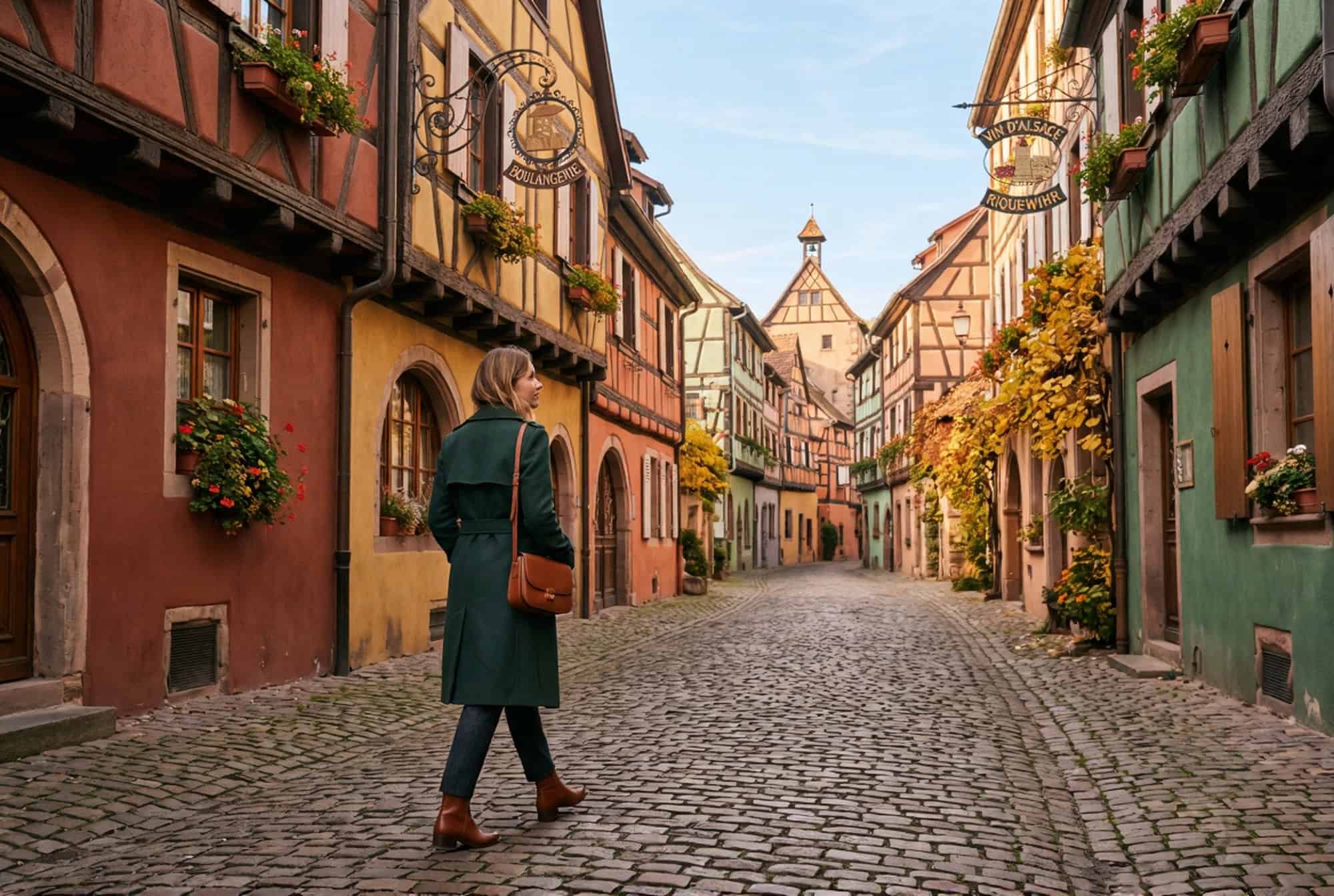
Alsace sits at the edge of France, pressed between the Rhine and the Vosges mountains, and it shows in everything including how the region dresses. The architecture is Germanic: steep-roofed half-timbered houses painted in forest green, rust, and ochre, stacked behind window boxes of bright geraniums. The food is German in portion and Alsatian in refinement: choucroute, baeckeoffe, flammekueche, and the wines, the Rieslings and Gewürztraminers that come from the thin strip of limestone and clay between the Vosges foothills and the Rhine plain.
The dressing register here is not Parisian. It is quieter, more rooted, and more structured. The German influence runs through it: a preference for solid quality over visible label, for layers that work rather than layers that signal, for outerwear that handles the weather without apology. Alsace has four genuinely distinct seasons, and the wardrobe shifts with each of them more than it does anywhere else in France.
The most visited version of Alsace is the Christmas market version: Strasbourg and Colmar in December, the towns along the Route des Vins strung with lights, mulled wine in ceramic cups, the cold air carrying the smell of cinnamon and pine. That version is real and worth planning around. But the spring wine route in April, the summer villages in July, and the amber harvest light of October are all equally worth dressing well for.
The Regional Colour Departure
Vosges Forest Green
The deep, saturated green of the pine forests that cover the Vosges ridge above the wine villages. Not a bright green or an olive but something denser, closer to the dark pine itself. This is the anchor colour of the Alsatian wardrobe and the one that makes everything else in the palette work. A forest green coat or a hunter green knit reads as native to this landscape in a way that navy, which would be the equivalent in Paris, does not.
Colmar Ochre
The warm yellow-gold of the painted facades in Colmar’s Petite Venise quarter and the mustard tones of the Alsatian pottery and glassware. Used as an accent rather than a base: an ochre scarf over a forest green coat, or a mustard-toned leather bag against dark trousers. It mirrors the light of the autumn vineyards and the painted window frames of the Route des Vins villages.
Timber Red
The rust and terracotta tones of the older half-timbered structures, the ones that have not been repainted in decades and have faded to something between brick and copper. A warm, lived-in red that works in a wool scarf, a knit top, or a leather glove. It stops the forest green and ochre palette from running too dark and adds the warmth the region requires from October through March.
Rhine Grey
The cool, slightly blue-toned grey of the Rhine water on an overcast day and the slate roofs of the older Strasbourg buildings. The sophisticated neutral of the Alsace palette, it works as a trouser, a fine knit, or a cashmere layer. Warmer and more interesting than charcoal, cooler than stone, it sits between the forest green and the ochre accents without pulling toward either.
Riesling Gold
The pale, greenish-gold of a glass of Alsatian Riesling held up to the light. Used as a very light accent in a silk scarf or a fine-knit camisole layer. Not a dominant colour but the one that prevents the palette from becoming too heavy when the full Alsatian winter wardrobe is assembled.
The Terrain Reality Check
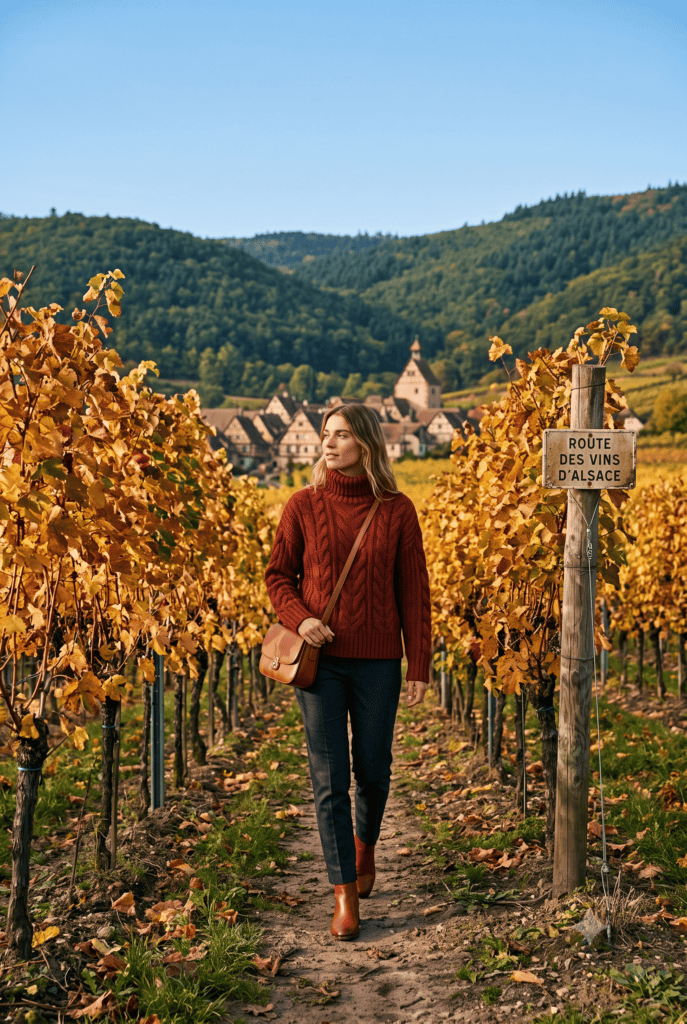
The Route des Vins runs for 170 kilometres through the Alsatian wine villages from Marlenheim in the north to Thann in the south. Most of the famous villages, Riquewihr, Ribeauvillé, Eguisheim, Kaysersberg, are compact and walkable, but the vineyard paths between them involve gravel, clay soil, and inclines that require a proper sole. A leather ankle boot with a rubber tread is the right shoe for the wine route: it handles the vineyard paths and reads correctly on the cobblestones of the village streets.
Strasbourg is a flat city built on a series of islands in the Ill river, and the historic centre, the Grande Île, is almost entirely cobblestone. The Cathedral of Notre-Dame rises at the centre and the walk from there through the tanner’s quarter to the European Parliament buildings along the river is one of the finer urban walks in France. Flat shoes throughout.
The Vosges mountains above the wine villages offer hiking in summer and ski touring in winter. If the trip includes time in the mountains, the wardrobe needs a technical layer over the base Alsace capsule. A waterproof shell and proper hiking boots are additions, not replacements, for the main capsule.
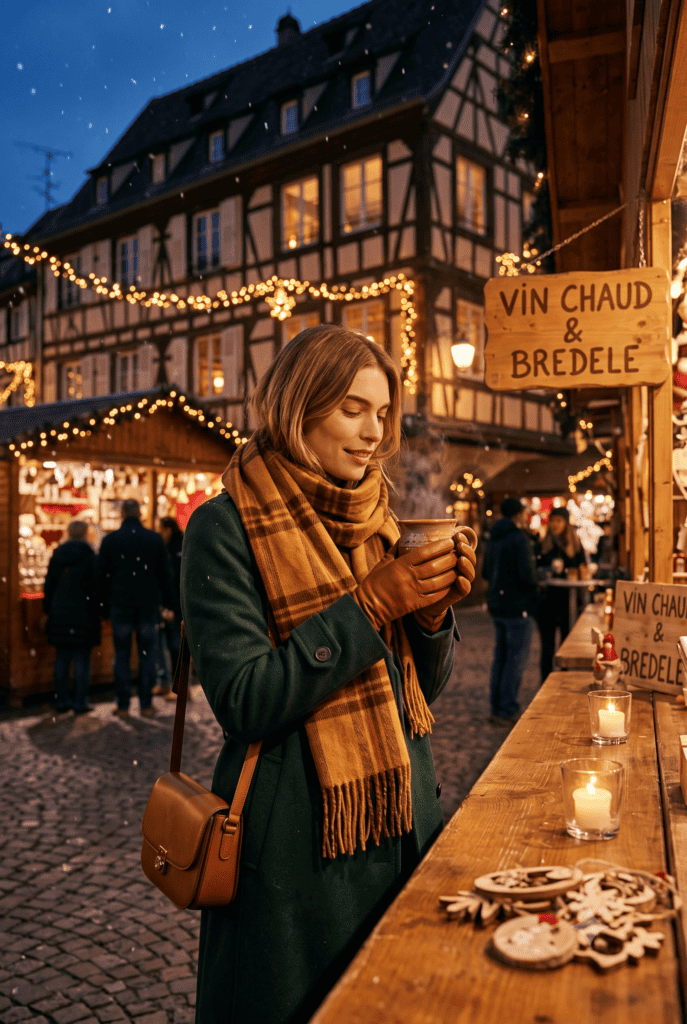
The Christmas market period, late November through December, brings genuine cold. Temperatures in Strasbourg and Colmar regularly drop below zero in December. Standing outside at a Christmas market for two hours requires proper insulation: a heavyweight coat, a warm hat, lined gloves, and boots that can handle icy cobblestones.
The Alsace-Specific Pieces
The Heavyweight Wool or Wool-Blend Coat
The most important single piece in the Alsace capsule for autumn and winter. Not a trench coat and not a light layer, but a properly structured, heavyweight coat in forest green, charcoal, or camel. This coat does the work that no amount of layering beneath it can replicate: it blocks the wind that comes off the Rhine plain and the Vosges, keeps the cold from reaching the knits beneath, and reads correctly in every Alsatian setting from a Strasbourg restaurant to a vineyard walk to a Christmas market. Buy the best version you can afford. This coat will be worn every day.
The Chunky Knit or Heavy Wool Sweater
A cabled knit or a substantial wool sweater in forest green, timber red, or Rhine grey. Alsace calls for knitwear with weight to it: the fine merino crewneck of the Paris capsule is not enough here from October through March. The knit needs to be thick enough to wear on its own indoors and warm enough to layer under the coat outside. A cabled turtleneck in particular works from a wine cave visit in the morning to a flammekueche dinner in the evening without changing.
The Tailored Dark Wool Trouser
A slim or straight-cut trouser in dark charcoal or ink navy, in a wool or wool-blend fabric. This is the trouser that goes from the Riquewihr cobblestones to the Strasbourg restaurant to the Colmar Christmas market without looking out of place in any of them. The wool fabric is warmer than cotton and holds its shape better after a day of walking. The darker tones pick up the Alsatian palette without requiring colour coordination.
The Leather Ankle Boot with Rubber Sole
The only shoe the Alsace capsule truly needs for three seasons. A leather ankle boot in cognac or dark tan, flat or with a block heel no higher than three centimetres, with a proper rubber sole. It handles the vineyard gravel, the cobblestones of Strasbourg and Colmar, and the occasional icy pavement of December without changing. The cognac leather picks up the Colmar ochre tones of the palette and warms the dark trouser and coat combination.
The Wool or Cashmere Scarf
In Alsace the scarf is a functional piece before it is a decorative one. A large wool or cashmere scarf in timber red, ochre, or a plaid that pulls together the palette does two things: it adds the warmth the coat collar alone cannot provide in the December cold, and it introduces the colour and texture that the darker base of the Alsace wardrobe needs. Buy a quality version. A thin or synthetic scarf is not warm enough and does not drape correctly.
The Cultural Register of Alsace
Alsace has a dress culture that sits between French refinement and German practicality, and the result is something that prioritises quality and function over label and trend. The region is not fashion-forward in the Parisian sense. It is well-dressed in a more rooted way: good wool, proper boots, a coat that was worth buying. The restaurant culture in Strasbourg is formal enough to require a step up from the wine route daytime clothes. A wool trouser, a good knit, and a leather boot cover the evening standard without requiring a full change.
The wine caves and wine domaines along the Route des Vins welcome visitors in casual but not sloppy dress. The cellar temperature is constant and cool even in summer: a layer is useful regardless of what the outside temperature is. Many of the caves have uneven stone floors; a heel is a bad idea.
The Christmas markets of Strasbourg and Colmar are outdoor events lasting two to three hours in cold weather. The dress code is purely practical: whatever keeps you warmest while looking like you made an effort. The local women wear their heavyweight coats, their best scarves, their warmest boots, and they look correct for the occasion.
The Strasbourg Cathedral and the other religious buildings in the region expect the same standards as anywhere in France: covered shoulders and knees. A scarf in the bag resolves this. The winstubs, the traditional Alsatian wine taverns, are casual and warm and the dress code is relaxed, but nobody arrives in activewear.
The Fabrics for This Region
Wool in its various weights is the primary fabric of the Alsace capsule. A heavyweight wool coat, a chunky knit, a wool trouser, and a wool-cashmere scarf cover the base wardrobe from September through April. In summer, the region is warm but rarely hot in the way that Provence is, and a linen shirt or a cotton dress under a light wool cardigan covers most of June and July.
Cashmere earns its place in the Alsace capsule more than in the Paris capsule because the cold here is more sustained. A cashmere mid-layer, a fine-knit turtleneck or a thin V-neck, adds meaningful warmth without bulk under the coat and packs in very little space.
Leather in the boots and the bag is the right choice for the terrain and the aesthetic. The cobblestones and vineyard paths require a leather that improves with wear and a rubber sole that grips. A leather bag in cognac or dark tan ages well in this climate and reads correctly against the wool palette.
Avoid synthetic outerwear for the main coat. A polyester puffer is right on a ski slope and wrong on on the cobblestones of Colmar. The wool coat is the right choice for the Alsatian aesthetic even if it requires more care.
The One Piece You’ll Wish You’d Brought
Thermal or merino base layer leggings worn under the wool trousers for the Christmas market period or any sustained outdoor time in December and January. Standing outside at a Christmas market for two hours when the temperature is at or below zero makes the difference between a thermal base layer and bare legs into the difference between a good evening and a miserable one. They take almost no space, pack flat, and are invisible under the trouser. This is the piece that most people leave out and feel the absence of from the first cold evening.
The One Piece You Won’t Need
A light summer dress packed for the Christmas market period or autumn trip. The Alsatian autumn is colder than most visitors from southern or coastal France expect, and December is genuinely cold. A summer dress requires its own shoes, its own bag, and its own approach to the evening and has no role in the October-through-March Alsace wardrobe. If the trip is in June or July, a single cotton or linen dress is worth including. If it is in any other month, leave it out.
Planning Your Full France Trip?
This guide covers the specific demands of Alsace: the wine route villages, the Strasbourg cobblestones, and the Christmas market cold. For the broader wardrobe picture across all six French regions, visit the France Packing Guide: What to Pack for Every Region. If your trip continues south to the rolling hills and market towns of Provence, the châteaux and cycling routes of the Loire Valley, or the sun-drenched coast of the French Riviera, each has its own capsule guide. For destination planning, the Complete Guide to France covers every region in full.
Your Alsace Capsule: The 12 Pieces
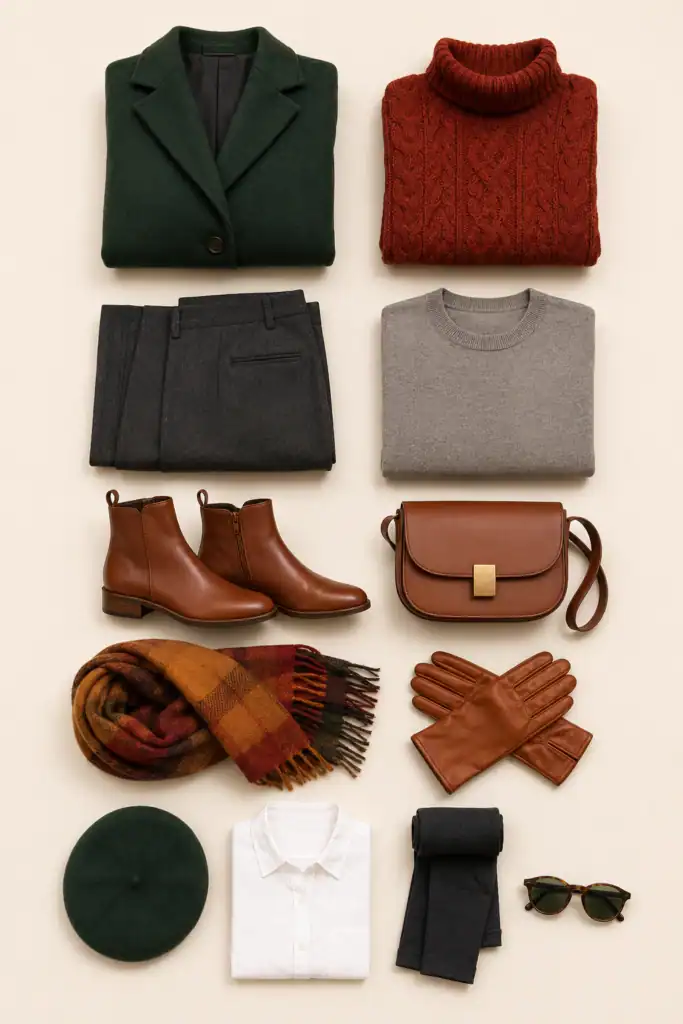
Shop the Alsace capsule. Every piece is linked below.
Shop here:
- Heavyweight wool or wool-blend coat in forest green or camel > Jenkoon Women’s Wool Trench Coat
- Chunky cable-knit turtleneck in timber red or forest green > Amazon Essentials Women’s Long Sleeve Turtleneck Sweater
- Fine merino crewneck in Rhine grey or chalk white > 100% Pure 15.5 Micron Merino Wool for Women
- Slim or straight dark charcoal wool trouser > Women’s Classic Fit Wool Trouser
- Linen or cotton shirt in white or pale blue (summer layer) — Womens 3/4 Sleeve Button Down Shirts | V Neck Casual
- Merino thermal base layer leggings > 100% Merino Wool Leggings for Women
- Cognac leather ankle boot with rubber sole, flat or low block heel > Franco Sarto Womens Marcus Flat Ankle Bootie
- Structured cognac or tan leather crossbody bag > Leather Flapover Crossbody Handbag for Women
- Large wool-cashmere scarf in ochre, timber red, or plaid > Oxfords Cashmere 100% Lambswool Tartan Plaid Scarf
- Leather or wool-lined leather gloves in cognac or dark tan > REDESS Winter Leather Gloves for Women, Wool Fleece Lined
- Wool beret or structured felt hat in forest green or charcoal > Kangaroo Vintage French Beret – Unisex Wool Hat
- Polarised sunglasses in classic frame > FEISEDY Polarized Sunglasses for Women
Alsace is one of six chapters in the French wardrobe story. If your trip continues north to the boulevards of Paris, south to the lavender fields of Provence, the river châteaux of the Loire Valley, the sun-drenched coast of the French Riviera, or the alpine trails of the French Alps, each region has its own capsule guide. For the full cross-regional packing strategy, visit the Complete Guide to France.
Frequently Asked Questions
Alsace runs cooler and more continental than the rest of France, closer in feel to nearby Germany. Pack layers: a base layer top, a knit or cardigan, and a packable jacket. Comfortable walking shoes handle the half-timbered village streets and vineyard paths well.
Yes, genuinely cold, especially if visiting the Christmas markets in Strasbourg or Colmar. Winter temperatures regularly sit near or below freezing. Pack a real insulated coat, gloves, a warm hat, and waterproof boots rather than a light jacket.
Layer heavily: thermal base layers, a warm sweater, an insulated coat, and waterproof boots. You’ll be standing outdoors for extended periods browsing stalls. Gloves and a scarf matter more here than at almost any other French destination on this site.
Alsace summers run pleasantly warm, typically 22-27°C, without the intense heat of southern France. Light layers work well: breathable tops, a light cardigan for evenings, and comfortable walking shoes for exploring vineyard villages like Riquewihr and Colmar.
Comfortable closed-toe walking shoes with good grip handle the cobblestone streets of half-timbered villages and uneven vineyard paths. If your trip includes any wine route walking, prioritize sturdy soles over fashion sneakers.