
*This post may contain affiliate links for which I earn commissions.*
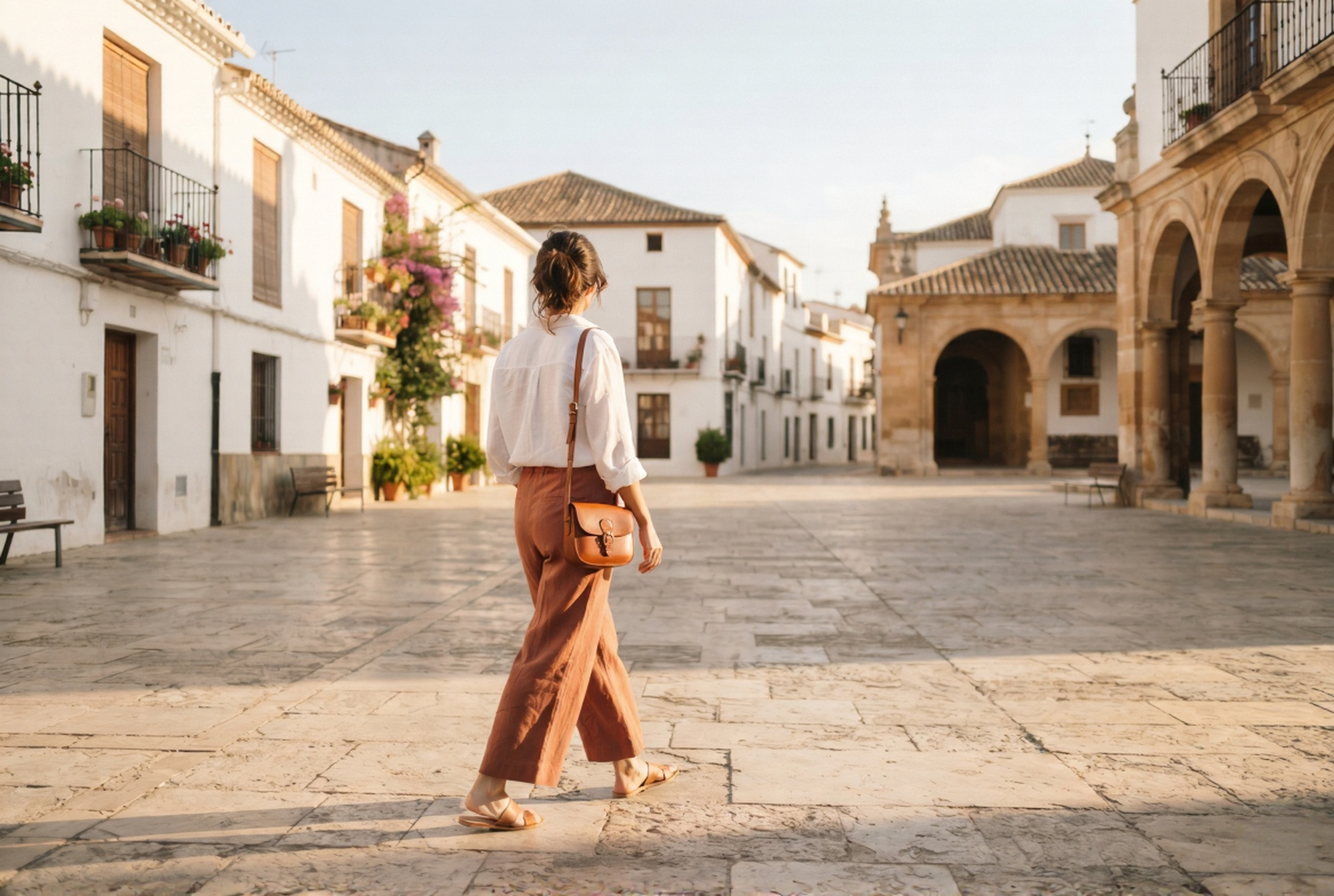
Spain does not ease you in. Madrid hits you with noise and heat and the particular energy of a city that eats dinner at ten and considers midnight early. Barcelona has a different rhythm entirely, cooler, more considered, facing the sea. Andalusia asks you to slow down so completely that you start to wonder why you were ever in a hurry. San Sebastián feeds you so well that everything else feels like a distraction. The Balearics want linen and salt air and nothing complicated. This guide covers all of it.
Spain dresses differently in every region. This guide covers the national aesthetic, the regional distinctions, and everything in between.
The Spanish Aesthetic
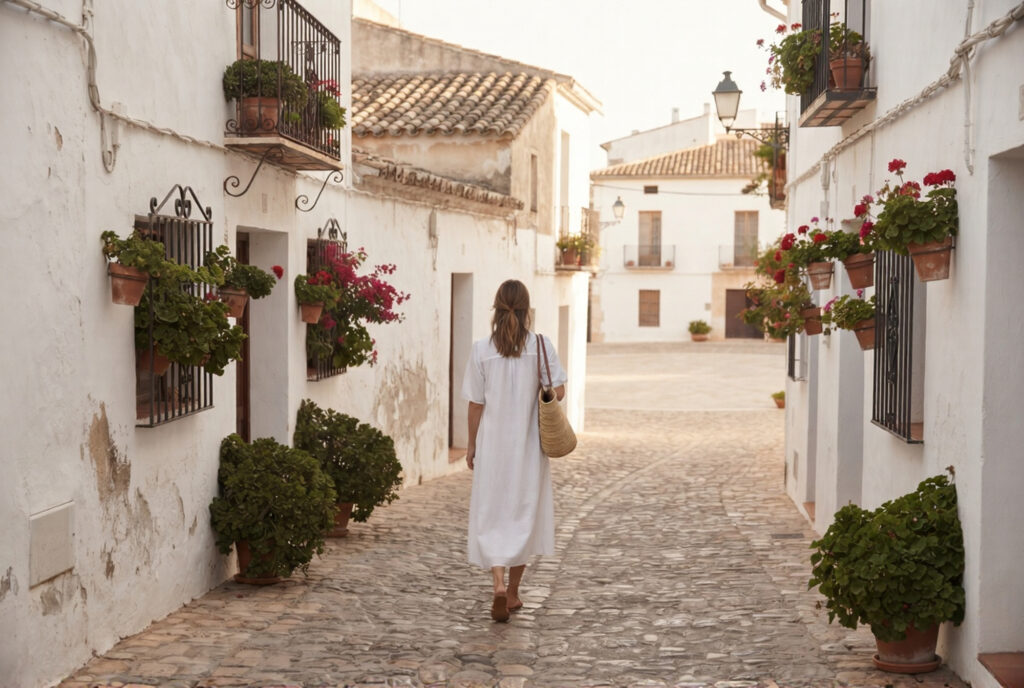
The Spanish approach to dressing is harder to summarise than the French or Italian version, and that is part of what makes it interesting. It is not built on a single governing principle. Instead, it shifts by region, by time of day, and by the occasion in ways that can feel unpredictable until you understand what is driving them.
The constant underneath all of it is a genuine investment in looking good. This is not the French version, which is quiet and private. Spanish style is more social, more outward-facing. You dress for the street, for the evening, for the people you are meeting. The evening paseo, the slow walk through town in the hour before dinner, is still a real event in Spain, especially in the south and in smaller cities. People dress for it. The children dress for it. It is taken seriously.
Quality matters in Spain, but the relationship with it is different from Italy. Italian dressing is built around the quality of individual pieces: the fabric, the make, the label. Spanish dressing tends toward the whole look: colour, proportion, the way pieces work together on the body. A Spanish woman in a bright sundress and flat sandals with good posture and a confident walk looks considerably better than the same outfit on someone who hasn’t bought into the register.
As a visitor, the most useful thing to know is that Spain rewards colour and confidence more than restraint and understatement. The muted neutral palette that reads as refined in Paris can read as dull in Seville in July. This does not mean you need to abandon everything you know about packing light. It means understanding when to add warmth and when the neutral base already works.
The Universal Colour Palette
The Spanish palette is warmer and more saturated than France’s and less disciplined than Italy’s. It draws directly from the landscape: the terracotta and white of Andalusian villages, the deep blues of the Mediterranean, the ochres and dusty pinks of the Castilian meseta, the greens of the Basque Country.
White
Everywhere in Spain, particularly in the south. Not écru or ivory but a clean, bright white that works under the direct sun rather than washing out in it. Worn in cotton and linen in Andalusia all summer. The whitewashed villages of the Alpujarras and the coast make everything else look overdressed by comparison.
Terracotta
The orange-red of the Spanish roof tiles, the walls of the Alhambra, the soil of the central meseta. Not an accent colour in Spain as it is in France but a genuine base tone. Works as a dress, a trouser, a linen shirt. More wearable in Spain than almost anywhere else in Europe because the landscape makes it look inevitable.
Deep Mediterranean Blue
Darker and richer than the French navy. The blue of the Costa Brava sea on a clear September day, the tilework in Seville, the pottery of Andalusia. Works as a trouser or a dress or a structured linen shirt. It reads as both coastal and urban, which is useful in a country where those two registers frequently overlap.
Ochre and Saffron
The yellow-golds of the Spanish interior: the dry grasslands of Castile, the saffron in a Valencian paella, the late afternoon light in Madrid. Not a colour to wear in large quantities, but a terracotta-ochre dress or a saffron scarf does exactly what the landscape suggests it should in both the city and the south.
Olive
Specifically the grey-green of the Spanish olive tree, which is drier and more silver than the Italian version. It runs through the landscape of Andalusia and Extremadura and works in clothing in the same way: as a neutral that is warmer and more interesting than beige but more understated than terracotta.
Dusty Pink
The pink of old Seville façades and Barcelona modernisme details. Not a primary colour but a useful addition to the neutral base. A dusty rose linen dress or a soft pink cotton shirt sits perfectly in the Spanish palette without looking too considered or too fashion-forward.
The Country-Wide Foundation Pieces
Spain is hot for a long part of the year and much of the country sits at altitude, which means warm days and surprisingly cool evenings even in summer. The foundation pieces that work across all regions prioritise breathability during the day and the ability to add a layer quickly after sunset.
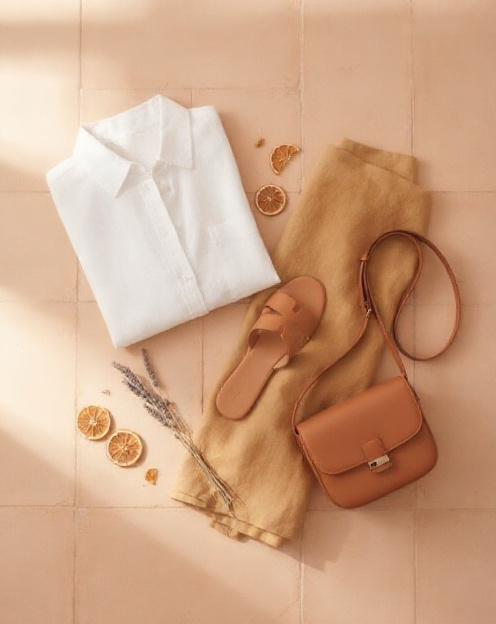
The linen shirt is the cornerstone of the Spanish wardrobe in a way it is not quite anywhere else in Europe. In France, linen is summer coastal fabric. In Spain, it is year-round city fabric, worn in Madrid in September just as readily as on a Balearic beach in July. The cut that works best is slightly relaxed, with a clean collar and enough body to be tucked or untucked without losing its shape. White or pale blue for the south, deeper tones for the cities. Massimo Dutti does this well and at a price that makes sense for travel, where clothes get worn hard.
Trousers in Spain run slightly wider than the French slim-straight. Not wide-leg, but a mid-straight or relaxed-straight cut that allows air to move and works with sandals as well as loafers. Linen or a linen-cotton blend in warmer months. A lightweight cotton twill for spring and autumn, particularly in the cooler north. The length should finish cleanly at the ankle: too long and the cobblestones will ruin the hem within a day.
Footwear is where Spain parts company most clearly from Italy. The leather sandal is the dominant shoe of the Spanish summer, worn in contexts where Italy would still reach for a loafer. A well-made leather sandal, flat or with a very low heel, handles everything from a Barcelona market to a Seville tapas bar to a hike up to a hilltop village. The key quality indicator is the sole: rubber for grip on marble and wet stone, and thick enough to protect against the heat of the pavement in midsummer Andalusia. Birkenstock’s Arizona in oiled leather works, but the Spanish brand Carmina makes sandals with better arch support for long walking days.
For evenings and cooler regions, the ankle boot earns its place from October through April. A block heel rather than a stiletto: you are walking on cobblestones in San Sebastián’s old town, not a flat surface. A clean tan or cognac leather works across all the regional palettes.
The lightweight blazer functions differently in Spain than in France. It is less of an everyday piece and more of an evening anchor, worn over a linen dress or a simple shirt and trousers when the temperature drops after dinner. An unstructured linen or cotton blazer in white, navy, or terracotta covers most Spanish evenings without adding weight to the bag.
The bag that works best in Spain is medium-sized, structured, and closes securely. Spain has the highest rate of pickpocketing of any country in Western Europe, concentrated in Barcelona, Madrid, and the major Andalusian cities. A crossbody bag that closes with a zip or a snap rather than an open tote is more than a style choice. Strathberry’s crossbody range works well here; so does anything from a Spanish leather goods market that closes properly.
The Cultural Dressing Notes
The most important cultural code in Spain is the one around time. Spain operates on a schedule that is roughly two hours behind the rest of Europe. Lunch runs from two until four. The evening starts at nine. Dinner at ten or later is completely normal, even with children present. This matters for dressing because it means the transition between day clothes and evening clothes happens later, and the distinction is more marked than in countries where everyone eats at seven.
The evening transition is real. In Seville, in San Sebastián, in Valencia, in the smaller cities across the country, changing for dinner is not optional among locals. This does not mean formal: it means clean, pressed, deliberate. A fresh linen shirt or a simple dress instead of the outfit you wore to the market and the museum. Spain notices this change and responds to it warmly.
Religious sites follow the same rules as elsewhere in southern Europe: covered shoulders and knees for cathedrals, churches, and mosques. The Mezquita in Córdoba and the Sagrada Família in Barcelona both enforce this at the door. A scarf in the bag resolves it.
Beach and town are more separated in Spain than in France. The beach culture, particularly on the Costa del Sol, the Costa Brava, and the Balearics, is relaxed about swimwear in the immediate beach area, but stepping into a town centre or a market in a swimsuit is unusual and not particularly welcome. A cover-up or a change of clothes for any time spent away from the waterfront is the right call.
In the Basque Country, the dressing register shifts noticeably. San Sebastián and Bilbao are considerably more formal than Andalusia. The bar food scene, the pintxos bars, is casual, but the restaurant culture is serious and the locals dress accordingly. A blazer and good shoes are not out of place in a San Sebastián restaurant on a Friday night. They are expected.
Climate Overview by Season
Spring (March to May)
Spain’s most varied season by region. Madrid and the interior can be genuinely cold in March and warm by May. Andalusia flowers spectacularly in April, warm enough for linen during the day and cool enough for a jacket in the evening. The Basque Country stays green and mild but damp. The Balearics wake up slowly: May is the first month that feels reliably warm enough for the beach. Layers throughout: a light jacket or blazer, the ability to add or remove a linen layer quickly.
Summer (June to August)
The Spanish interior in summer is ferocious. Madrid hits the high thirties regularly in July. Seville and Córdoba frequently exceed forty degrees. The coast is more manageable, saved by sea breezes, but still genuinely hot. Only the Basque Country offers relief: San Sebastián and Bilbao are warm rather than hot, green rather than scorched. The Balearics are at their most crowded and their most beautiful from June through August. Pack only natural fibres from June onwards. Everything synthetic becomes unwearable.
Autumn (September to November)
The finest season to visit most of Spain. The heat breaks in September but the sun stays. Andalusia in October is warm, golden, and quiet. The Rioja harvest runs through September and the vineyard landscapes are as good as anything in France. Barcelona in October is the best version of the city: warm days, cool evenings, fewer people. The Basque Country turns properly green. Add a layer from October: a trench coat or a light wool jacket covers most evenings comfortably.
Winter (December to February)
Winter in Spain divides into three experiences. The ski season in the Pyrenees and the Sierra Nevada, which runs from December through March. The mild south, where Seville and Málaga are perfectly pleasant in January, the sort of weather that sends Northern Europeans south in considerable numbers. And Madrid, which is colder than its latitude suggests, regularly below zero in January, requiring a proper wool coat and serious boots. The Canary Islands maintain summer temperatures year-round and operate on their own seasonal logic entirely.
Choose Your Spain Region
Spain’s regions have distinct climates, distinct cuisines, distinct languages in several cases, and distinct dressing registers. What reads as correctly dressed in San Sebastián can look overdone in a beach town on the Costa del Sol. What works in Ibiza Town does not work in a Madrid business district. Use the guide below.
MADRID & CASTILE
The Capital and the Interior
Dressing register: Urban, stylish, and considerably more formal than the coasts. Madrid is a working capital city that takes evening dressing seriously.
Key destinations: The Prado, the Reina Sofía, Retiro Park, the Rastro market, Toledo, Segovia, Salamanca.
Distinct because: Madrid sits at 650 metres altitude, which makes it hotter in summer and colder in winter than its latitude suggests. It is also the most fashion-forward city in Spain: the Gran Vía shopping district is serious, and the Malasaña and Chueca neighbourhoods have a strong independent style culture. Dressing for Madrid means smart casual at minimum during the day and a genuine evening outfit for dinner. The interior of Castile, day trips to Toledo or Segovia, requires comfortable shoes above everything else: the old towns are steep, cobbled, and long.
→ Read the Madrid Capsule Wardrobe Guide
BARCELONA & CATALONIA
Barcelona, Costa Brava, Tarragona, the Pyrenees
Dressing register: Mediterranean cool, architecturally aware, and more relaxed than Madrid without being casual.
Key destinations: The Sagrada Família, Park Güell, the Gothic Quarter, the Barceloneta beach, Costa Brava, Montserrat.
Distinct because: Barcelona is a city that faces the sea and dresses accordingly. The beach is genuinely integrated into daily life in a way it is not in Madrid, which means the transition between beach and city happens more fluidly. The Gothic Quarter and the Eixample require slightly different registers: the old town is tourist-dense and loud, the Eixample is residential and quieter, and dressing for the latter means fitting into a neighbourhood rather than a sightseeing crowd. Catalonia has its own cultural identity and the dressing register is slightly closer to southern France than to Andalusia.
→ Read the Barcelona Capsule Wardrobe Guide
ANDALUSIA
Seville, Granada, Córdoba, Málaga, the White Villages, the Costa del Sol
Dressing register: Warm, colourful, and built for heat. The most distinctly Spanish dressing register in the country.
Key destinations: The Alhambra in Granada, the Mezquita in Córdoba, Seville’s old town and the Alcázar, Ronda, the Pueblos Blancos, Málaga.
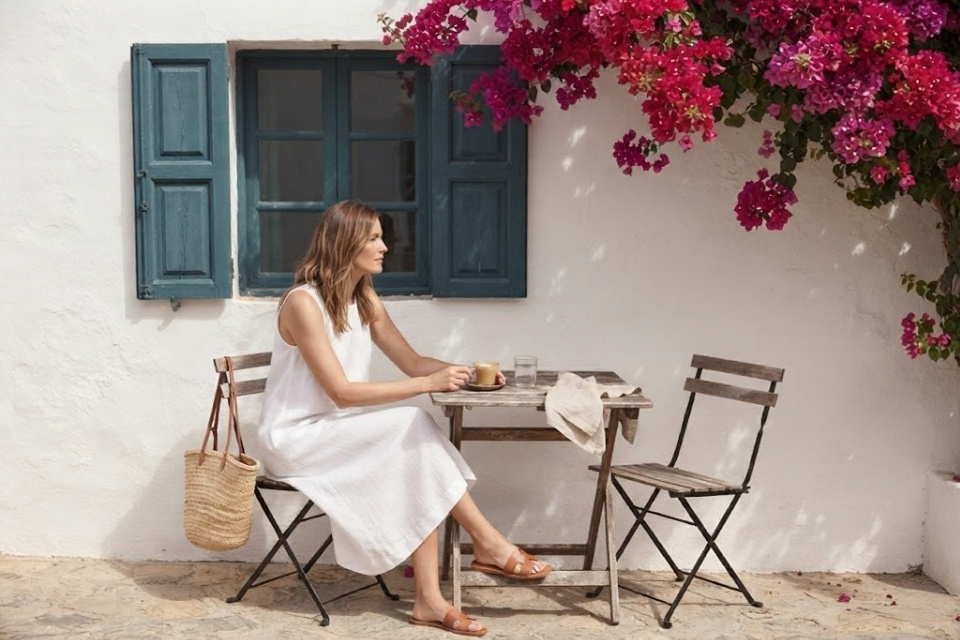
Distinct because: Andalusia is where Spanish style is at its most vivid and least self-conscious. White linen, bright colour, flat sandals, the willingness to dress up properly for the evening regardless of how hot the afternoon was. The Alhambra and the Mezquita both require covered shoulders and knees: a loose linen cover-up over a sundress handles both without adding much to the day’s heat. The flamenco influence on the local aesthetic is real, not in the sense that people dress in flamenco costumes, but in the sense that colour, drama, and movement in clothing are considered values rather than excesses.
→ Read the Andalusia Capsule Wardrobe Guide (coming soon)
THE BASQUE COUNTRY
San Sebastián, Bilbao, Vitoria-Gasteiz
Dressing register: The most formal dressing register in Spain. Northern European precision meets Spanish warmth.
Key destinations: San Sebastián’s La Concha beach and pintxos bars, the Guggenheim Bilbao, the Rioja wine country, Getaria.
Distinct because: The Basque Country has more Michelin-starred restaurants per capita than anywhere else in the world, and the local relationship with food extends to how people dress for it. San Sebastián on a Friday evening is as well-dressed as any city in Spain. The climate is also genuinely different: green, damp, mild, and more similar to northern France than to Andalusia. The colour palette shifts accordingly: deeper tones, more structure, fewer sundresses. Bring at least one dinner outfit that could hold its own in a serious restaurant.
→ Read the Basque Country Capsule Wardrobe Guide (coming soon)
VALENCIA & THE EAST COAST
Valencia, Alicante, Murcia, Costa Blanca
Dressing register: Coastal, relaxed, and sun-saturated. The most Mediterranean of Spain’s mainland regions.
Key destinations: Valencia’s Ciudad de las Artes y las Ciencias, the Mercado Central, the Costa Blanca beaches, Alicante’s Castillo de Santa Bárbara.
Distinct because: Valencia gets more sunshine than almost anywhere else in Europe, and it shows in how people dress. The city itself is more relaxed than Madrid and more genuinely local than Barcelona. The paella is eaten at Sunday lunch, two in the afternoon, at a table of twelve, and everyone looks right for the occasion without having tried visibly hard. The east coast is less internationally crowded than the Costa del Sol and the Balearics, which gives it a more local feel and a dressing register that is beach-adjacent rather than beach-based.
→ Read the Valencia Capsule Wardrobe Guide (coming soon)
THE BALEARIC ISLANDS
Mallorca, Menorca, Ibiza, Formentera
Dressing register: Island luxury, unhurried, and distinctly different between islands. Ibiza and Formentera differ considerably from Mallorca and Menorca.
Key destinations: Palma de Mallorca, Menorca’s Camí de Cavalls coastal path, Ibiza Town, Formentera’s beaches.
Distinct because: The Balearics are four distinct islands with four distinct registers. Mallorca is the most varied: Palma is a genuinely sophisticated city with good restaurants and a strong local culture, while the resort areas of the south and east operate on beach-holiday logic entirely. Menorca is quieter, greener, and more understated: the dressing register is relaxed but not loud. Ibiza Town has a fashion identity that is its own category, bohemian and body-conscious and unapologetically showy. Formentera is the simplest: a sandal, a swimsuit, a linen shirt, and nothing else required.
→ Read the Balearic Islands Capsule Wardrobe Guide (coming soon)
VISITING MORE THAN ONE REGION?
Many Spain itineraries combine Madrid with Andalusia, or Barcelona with the Costa Brava, or string together a north coast route from San Sebastián to Galicia. Packing for more than one region from a single carry-on requires a neutral base that holds its own everywhere and one or two destination-specific additions.
→ Read Spain in One Bag: A Capsule Wardrobe for Every Region
Regions at a Glance
| Region | Primary Vibe | Key Fabric | Footwear Focus |
| Madrid & Castile | Urban, stylish, altitude-hot-cold | Cotton / Lightweight wool | Leather loafer / ankle boot |
| Barcelona | Mediterranean cool, architecturally aware | Linen / Cotton | Leather sandal / clean sneaker |
| Andalusia | Warm, colourful, heat-built | Pure linen / Cotton | Flat leather sandal |
| Basque Country | Formal, green, food-serious | Cotton / Light wool | Leather ankle boot |
| Valencia & East | Coastal, sun-saturated, relaxed | Linen / Cotton voile | Leather sandal / espadrille |
| Balearic Islands | Island luxury, four distinct registers | Linen / Silk cotton | Flat sandal / espadrille |
Every region of Spain has its own dressing logic. The north is formal and green. The interior is hot and urban. The south is vivid and unhurried. The islands range from quietly sophisticated to unapologetically showy. Pack for where you are going, not for a generic Spain that does not exist.
Start with your region above. For destination planning beyond what to wear, the Spain Tourism Authority covers all regions in depth and is updated regularly.